
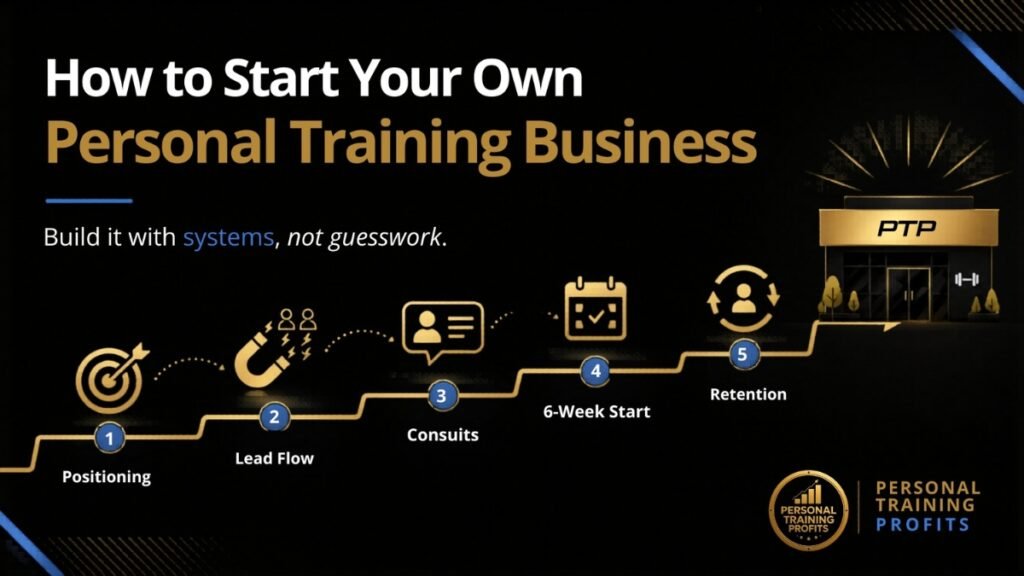
Most personal trainers do not fail because they lack coaching skill. They struggle because the business side is fuzzy. Leads are inconsistent. Consults are unstructured. Pricing is improvised. Retention is accidental.
Starting your own personal training business is not about having a logo and an Instagram page. It is about installing a simple operating system that creates lead flow, consultations, programs, and retention in a repeatable way.
📌 Key Takeaways
- “Personal training business” is bigger than studios. There are 5 common paths, and one long-term destination.
- The fastest start is a simple offer, a clear consult process, and a 6-week foundation phase.
- Three sessions per week is the default recommendation for best results.
- Track a few numbers weekly so you know what to fix next.
- Build systems first, then scale, instead of trying to scale chaos.
🧭 Who this is for
This is for employee trainers, independent trainers, in-home trainers, online or hybrid coaches, and studio owners in progress who want a real in-person business that can grow over time. It is also for trainers who are tired of feeling stuck, capped, or dependent on someone else’s rules.
⚠️ The problem
Most trainers start backwards.
They start with:
- social posts and “content”
- random pricing
- inconsistent follow-up
- selling sessions one at a time
- programming that changes constantly
Then they wonder why the business feels unstable.
A personal training business becomes predictable when it has:
- a clear audience
- a clear offer
- a clear consult process
- a structured starting phase
- simple tracking and retention systems
That is what separates a hobby from a business.
✅ The solution
Start with a simple business model that can evolve.
The goal is not to build the perfect studio on day one. The goal is to move through stages with systems:
- get positioned for a real market
- create consistent consultations
- sell a program, not random sessions
- deliver a 6-week foundation phase
- retain, reactivate, and grow
That is how a trainer becomes a business owner.
🧱 The framework: The 5 ways trainers run a business, and the smart path forward
1) Employee trainer
This is a valid starting point. You can learn fast, build confidence, and work with real people every day.
The limitation is that your income and control are capped by:
- the facility’s pricing rules
- policy changes and management changes
- schedule restrictions
- the fact that the gym owns the member base
If you are an employee trainer now, the goal is not to stay there forever. The goal is to use it as a training ground while you build business skills, track your numbers, and plan your next move.
What to build while you are still employed:
- a clear audience you want long-term
- a simple offer you can explain in one sentence
- a consult script and a follow-up rhythm
- your weekly numbers tracking habit
That way, when you move, you are not starting from zero.
2) Independent trainer inside a facility
This can be a step up from employment. You often keep more revenue and gain more flexibility.
The limitation is still dependence:
- the facility can change policies
- your access can be reduced
- you are still building inside someone else’s environment
- you may be blocked from creating a real branded experience
If you are an independent trainer now, the goal is to build your own lead flow and systems so you can later operate with less dependence on a facility.
What to build in this phase:
- lead sources you control (referrals, partnerships, local visibility)
- a consistent consult process
- a program-based offer instead of session-by-session selling
- a simple onboarding and retention rhythm
3) In-home trainer
This can work, especially early. The experience can feel private and comfortable for clients.
The limitations show up quickly:
- equipment is inconsistent
- travel time destroys schedule efficiency
- cancellations and reschedules hit harder
- scaling is difficult
If you are an in-home trainer, the goal is to treat it as a stage, not a forever plan. Build a consistent offer, a strong consult process, and a client journey that can later transition into a controlled location.
A practical way to think about this stage:
- use in-home to prove your offer and build testimonials
- tighten your time blocks and geography
- transition your best clients into a controlled space when ready
4) Online or hybrid coach
Online coaching can be valuable, but it is not the same service as in-person personal training. In-person means you are in the room, you control the environment and equipment, and you manage safety, pacing, and confidence in real time. Online coaching is remote support delivered through apps, calls, and messages, and execution happens somewhere else.
Online or hybrid can complement an in-person business well:
- as a follow-up option when in-person clients move away
- as a support layer between in-person phases
- as accountability and education layered on top of an in-person model
The risk comes when a trainer builds everything on online coaching alone and treats it as a “personal training business.”
Why online-only is fragile as a main business model
- Platform and algorithm dependence, one change can cut reach and inquiries overnight.
- Global competition and price pressure, you compete with every coach who speaks your language, and many undercut pricing with short-term challenge offers.
- AI and copycat risk, if your product is a spreadsheet, templates, and check-ins, larger platforms and AI-driven tools can replicate it at scale.
- Limited control over execution and results, you do not control equipment, space, distractions, or real-time movement quality.
- Weak local moat and higher churn, clients can switch to the next offer with one click, with less “place” and less stickiness.
- Third-party dependence, you rely on platforms for traffic and tools for delivery, and policies can change without warning.
- DM burnout, always-on messaging becomes the delivery model, and it is hard to scale without boundaries.
Hybrid can still be useful. The smart strategy is to build a defensible in-person model first, then use online coaching as a support channel, not the entire livelihood.
5) Your own location, the long-term destination
This is where the business becomes truly buildable.
A location does not have to be massive. It can start modest and evolve. The advantage is control:
- control the experience
- control the pricing model
- control the systems and standards
- build a team over time
Even if you start as a solo owner-operator, the goal is to design the business so it can later run with staff and systems.
🧱 How to start in the real world: A simple 6-step launch plan
1) Choose a market that actually buys
The biggest business opportunity is not “gym people.” It is the non-gym majority who want help but do not want the traditional gym scene.
This is why the deconditioned market matters. It is large, underserved, and retains well when the experience feels safe and measurable.
You do not need to abandon other markets. You just need a primary market you can serve consistently.
A practical positioning test:
- can you explain who you help in one sentence
- does that person recognize themselves immediately
- does your message feel welcoming, not intimidating
2) Sell a clear offer, not vague training
A strong offer reduces confusion and increases conversion.
A simple starting offer:
- a 6-week foundation phase
- default three sessions per week for best results
- private appointments
- clear progress tracking
- re-assessment at the end of 6 weeks
Clarity beats complexity. A prospect should understand the offer in 10 seconds.
3) Use a consult-first process
Most trainers lose sales because the process is messy.
A simple consult process:
- ask questions and diagnose
- confirm the real goal and the real barriers
- recommend the right start plan
- schedule the next step
No pressure. No hype. Just a professional recommendation.
4) Deliver a repeatable 6-week foundation phase
This is where most trainers either create retention or create churn.
Weeks 1–6 should focus on:
- safety and confidence first
- attendance as the first win
- measurable progress, not intensity theater
- a calm, consistent experience
- weekly check-ins on adherence and barriers
At the end of Week 6, run a re-assessment and prescribe the next phase. Retention becomes easier when progress is visible.
5) Track the 5 numbers that matter
You do not need complicated spreadsheets.
Track these weekly:
- booked consults
- show rate
- close rate
- retention
- sessions delivered
These numbers tell you what to fix next. They also keep you out of emotional decision-making.
6) Build toward a model that can scale
Scaling does not begin when you hire. It begins when you define roles and standards.
Even as a solo trainer, define the roles:
- Program Consultant (consults, enrollments, follow-up)
- Program Director (assessments, programming standards, re-assessments)
- Trainer (delivery and progress reinforcement)
- Admin (scheduling, billing, reminders, basic tracking)
You might cover all roles at first. That is fine. The point is to build a business that can hand roles off later without chaos.
🔧 Tools and templates you can copy
1) One-sentence positioning statement
“I help real people get stronger, healthier, and more confident through private appointments, a simple 6-week start, and measurable progress.”
2) Simple consult opener
“The goal today is to understand what you want, what has been getting in the way, and recommend a safe starting plan.”
3) 6-week program expectation line
“This first 6 weeks is about routine and measurable progress. We default to three sessions per week for best results, then we build from there.”
4) Weekly numbers tracker
Create a simple weekly note with:
- booked consults
- shows
- closes
- active clients
- sessions delivered
➡️ Next step
Thinking about your own place? What a small studio costs to open, what 18 clients across 54 sessions a week actually produce, and the arithmetic to run before you commit to a lease. → The numbers behind your own studio








Please help us by sharing on your favorite Social Media