
Systems and Operations

Systems and Operations covers the behind-the-scenes structure that makes a personal training business more predictable and profitable. Expect installable systems that reduce chaos, improve consistency, and protect your time, including scheduling standards, session delivery SOPs, onboarding, roles, reporting, and simple weekly KPIs. These principles help solo trainers and teams alike. The goal is repeatable processes that improve results, retention, and revenue, without relying on personality or constant firefighting.

Illustration of the Just Results Lifestyle Studios storefront, representing the late 1990s studio case study and turnkey business model concept

Case Study – Just Results Lifestyle Studios (1997–2000)

Most personal trainers only see the industry as it exists today. This case study is a different chapter: the point where I had full control to build the studio model the way I believed it should be built, systemized, turnkey, and designed for the deconditioned market from day one. It is also a credibility story. […]

Case Study – Just Results Lifestyle Studios (1997–2000) Read More »

, , , , ,
Laptop on a desk displaying “Time for Review,” representing a 15-minute weekly owner meeting and simple scorecard check-in

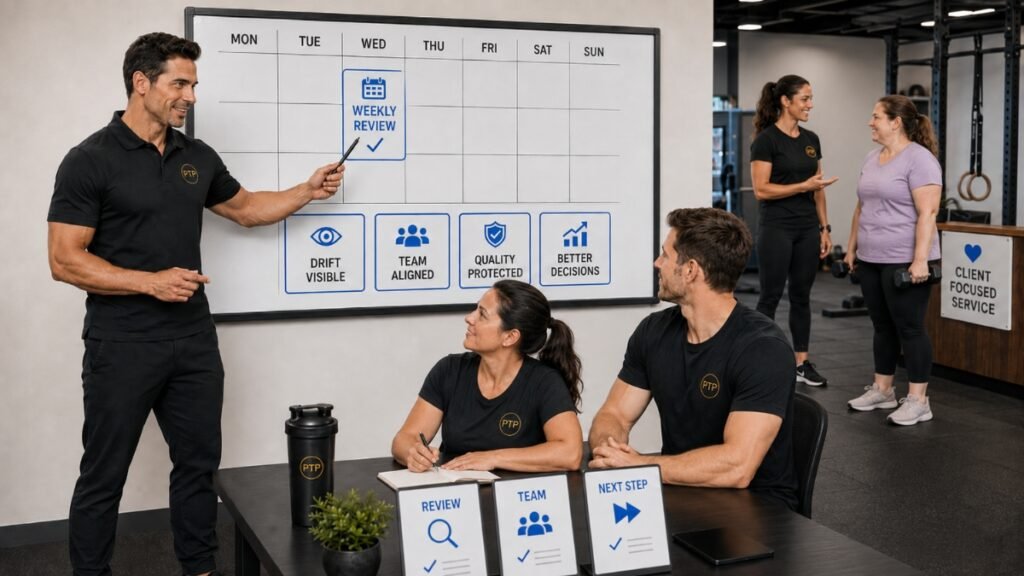
Weekly Review, The 15-Minute Owner Meeting

Most personal trainers don’t need more ideas. They need a simple operating rhythm so the business stops guessing and starts improving on purpose. A 15-minute weekly owner meeting does that. It forces clarity, keeps the business honest, and prevents the “busy but unstable” cycle. 📌 Key Takeaways 🧭 Who this is for This is for

Weekly Review, The 15-Minute Owner Meeting Read More »

, , , , ,
Infographic showing how to start your own personal training business, with 5-step pathway from positioning to retention and a systems-first message

How to Start Your Own Personal Training Business

Most personal trainers do not fail because they lack coaching skill. They struggle because the business side is fuzzy. Leads are inconsistent. Consults are unstructured. Pricing is improvised. Retention is accidental. Starting your own personal training business is not about having a logo and an Instagram page. It is about installing a simple operating system

How to Start Your Own Personal Training Business Read More »

, , , , ,
Personal training business owner coaching trainers, representing the shift from owner-operator to leader through delegation and systems

Owner to Leader, The Shift That Creates Freedom

Most personal trainers do not burn out because they dislike coaching. They burn out because the business depends on them for everything, sales, scheduling, delivery, admin, follow-up, and problem-solving. The shift from owner to leader is the point where a personal training business stops being a job and becomes a system. That is also where

Owner to Leader, The Shift That Creates Freedom Read More »

, , , ,
Perth skyline at sunset with Renouf Personal Training Centre logo, representing the 1992–1994 origin case study in Western Australia

Case Study – Renouf Personal Training Centre, Perth (1992–1994)

Most personal trainers only see the industry as it exists today. This case study goes back to the beginning, how a high-profile personal training center was built in the early 1990s, what made it explode in growth, and what lessons still apply today. It is also an honest origin story. Some things were right, some

Case Study – Renouf Personal Training Centre, Perth (1992–1994) Read More »

, , , , ,
Personal trainer holding a clipboard, representing a client journey SOP and a repeatable intake process from lead to 6 weeks

Client Journey SOP, From Lead to 6 Weeks

Most personal trainers don’t lose clients because they lack coaching skill. They lose them because the client experience is inconsistent. A simple client journey SOP fixes that. It turns chaos into a repeatable workflow, improves conversions, and makes retention predictable. This is the backbone of a real personal training business. 📌 Key Takeaways 🧭 Who

Client Journey SOP, From Lead to 6 Weeks Read More »

, , , , ,
Hand stacking wooden blocks, representing the 6-week foundation phase built step by step for a personal training business

The 6-Week Foundation Phase

Most personal trainers lose clients in the first 30–60 days, not because the training is “wrong,” but because the first phase has no structure. A 6-week foundation phase fixes that. It gives the client early wins, builds routine, and makes the next step obvious. This is the simplest way to turn a personal training business

The 6-Week Foundation Phase Read More »

, , , , ,
Studio math graphic showing the five numbers that matter, booked consults, show rate, close rate, retention, and sessions delivered

Studio Math, The 5 Numbers That Matter

Most personal trainers try to grow by working harder, posting more, or chasing more leads. That creates a busy calendar, but it does not create a predictable personal training business. Predictable growth comes from simple math. Not complicated accounting, just a small set of numbers that tell you what is working and what to fix

Studio Math, The 5 Numbers That Matter Read More »

, , , , ,
Two people having a calm consultation with a laptop, representing improving consult show rate with clear confirmation and reminders

Consult Show Rate, The Hidden Sales Lever

Most personal trainers focus on getting more leads. The faster win is often improving what happens after a lead books. Consult show rate is the hidden sales lever because it turns the same number of bookings into more real conversations, more enrollments, and more revenue. If your calendar looks full but sales still feel inconsistent,

Consult Show Rate, The Hidden Sales Lever Read More »

, , , , ,
Extinguished candle with smoke on a dark background, symbolizing personal trainer burnout

Why Personal Trainers Burn Out, and How Systems Fix It

Most trainer burnout is not caused by lack of passion. It is caused by a business model that depends on constant energy, constant selling, and constant improvisation. When the business runs on personality, the owner becomes the bottleneck, and the business becomes fragile. A business that runs on systems is different. It creates predictability for

Why Personal Trainers Burn Out, and How Systems Fix It Read More »

, , , , ,
Scroll to Top