
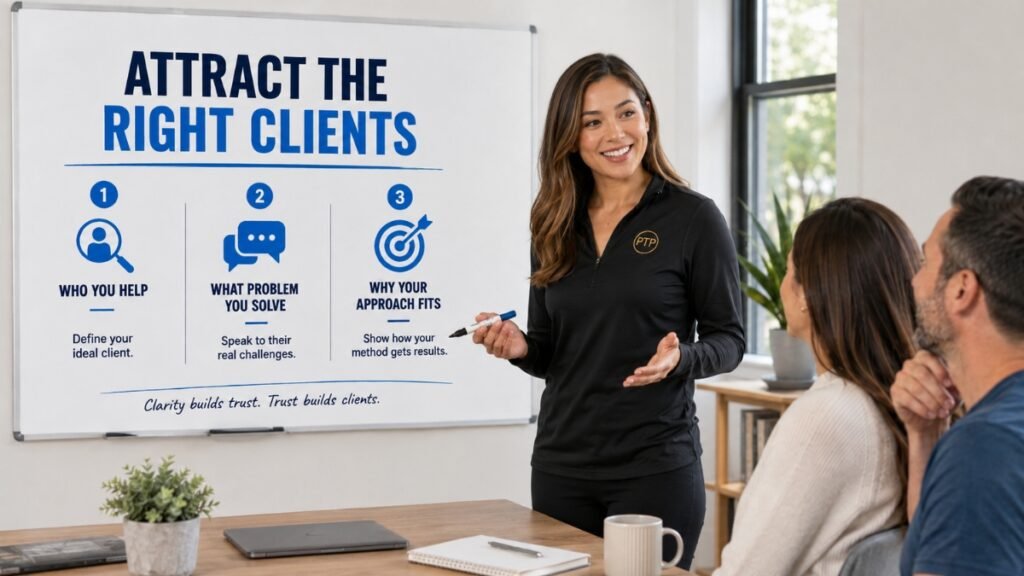
Most personal trainers describe their business in almost the same way.
They help people get fit, lose weight, become stronger, and feel healthier.
Those statements may be true, but they do not explain who the service is designed for, what has kept that person stuck, why this particular business is different, or why the prospect should choose it over every other trainer, gym, app, and online program.
Good positioning makes those answers clear.
It helps the right prospect recognize that your service was built for someone like them. It also filters out people who are unlikely to value the service, fit the model, or follow the process.
Positioning is not simply about finding clever words.
It is a business decision about who you help, what problem you solve, how you solve it differently, and what outcome you help create.
Prefer to watch? Here’s the full YouTube breakdown.
📌 Key Takeaways
- Positioning begins with business decisions, not slogans.
- “I help everyone get fit” is too broad to be meaningful.
- The strongest positioning describes the prospect’s situation, not only their age or gender.
- People do not usually buy personal training because they want sessions. They buy because they want help solving a problem.
- Your environment, assessment process, accountability, programming, and client experience can all create meaningful differentiation.
- Personal training should be positioned as a complete delivery system, not a collection of exercises.
- In-person personal training and online coaching compete through different business models.
- Clear positioning attracts suitable prospects and filters out poor-fit prospects before the consultation.
🧭 Who this is for
This article is for personal trainers who:
- struggle to explain what makes their service different;
- use broad phrases such as “I help people get fit”;
- attract enquiries from people who are not a good fit;
- compete mainly on price;
- feel invisible in a crowded local market;
- want to serve the deconditioned or non-gym majority;
- or need a simple positioning statement for their website, social media, consultations, and advertising.
The framework applies across different niches.
You may work with older adults, athletes, weight-loss clients, executives, beginners, deconditioned adults, or another defined market.
The questions change.
The positioning logic does not.
⚠️ The problem
Many trainers treat positioning as a copywriting exercise.
They sit down and try to invent a clever slogan, headline, or social media bio before making the underlying business decisions.
The words come first, but the business underneath them remains generic.
They offer similar sessions, use similar equipment, make similar promises, and speak to the same broad audience as everyone else.
That creates messages such as:
We help busy people lose weight and get fit.
There is nothing technically wrong with that statement.
The problem is that almost any gym, personal trainer, online coach, app, supplement company, or weight-loss program could say exactly the same thing.
The audience is broad.
The real obstacle is missing.
The delivery method is unclear.
There is no meaningful reason to choose one service over another.
The statement is not necessarily false.
It is simply easy to ignore.
✅ The solution
Strong positioning requires four clear decisions:
- Who do you help?
- What problem is keeping them stuck?
- How does your service solve it differently?
- What meaningful outcome do you help create?
A useful positioning statement can follow this structure:
We help [who] overcome [problem] through [how], so they can achieve [outcome].
The statement does not need to be clever.
It needs to be clear, relevant, believable, and supported by the actual service.
The operation must make the positioning true.
1️⃣ Positioning is a business decision
Positioning influences far more than your marketing copy.
It affects:
- the market you choose;
- the offer you create;
- the message you communicate;
- the way the service is delivered;
- the environment you provide;
- the price you can justify;
- the consultation process;
- and the clients you attract.
The real positioning work begins with questions such as:
- Who is this service designed for?
- What does that person need?
- What has failed them before?
- What level of support do they require?
- What should the experience feel like?
- What should the program include?
- What kind of environment will make them more comfortable?
- What outcome can the business credibly help create?
The marketing becomes powerful when the business underneath it has genuinely been designed around the person being described.
For example, a business cannot credibly claim to specialize in nervous beginners if the environment feels like a crowded bodybuilding gym.
It cannot promise accountability if missed appointments go unnoticed.
It cannot claim a structured process if every client receives an improvised session with no assessment, progression, or reassessment.
Positioning is not only what you say.
It is the alignment between the message, the service, and the client experience.
2️⃣ Good positioning attracts and filters
Many trainers are afraid that choosing a defined market will reduce their opportunities.
They worry that speaking directly to one type of client will cause everyone else to leave.
But useful positioning is not supposed to appeal equally to everybody.
It has four important jobs:
- Attract suitable prospects.
- Build relevance and trust.
- Explain why the service is different.
- Filter out poor-fit prospects.
The right person should see your message and think:
This sounds like it was designed for someone like me.
The wrong person may decide that another service is more appropriate.
That is not necessarily lost business.
It is useful filtering.
A highly independent athlete may not value a private, appointment-based service designed for adults who dislike gyms and need substantial accountability.
A deconditioned beginner may feel uncomfortable inside a performance facility built around competitive athletes.
Neither person is wrong.
They simply need different experiences.
A business becomes easier to operate when clients:
- understand what they are buying;
- value the way the service is delivered;
- fit the program;
- arrive with realistic expectations;
- and genuinely want the outcome being offered.
Clear positioning improves the quality of the enquiry before the consultation even begins.
3️⃣ Start with who you help
The word who means more than age, gender, occupation, or income.
Those details may be useful, but they do not fully describe the market.
A better definition considers:
- life stage;
- current condition;
- previous experience;
- main concern;
- emotional barriers;
- confidence level;
- and the amount of support required.
A 50-year-old experienced athlete and a 50-year-old who has avoided gyms for 20 years may share the same age, but they are not the same market.
The experienced athlete may want advanced programming, performance improvement, and technical refinement.
The deconditioned beginner may need reassurance, privacy, gradual progression, education, appointments, and consistent accountability.
They need different:
- messages;
- consultations;
- environments;
- programs;
- expectations;
- and client experiences.
That is why “I work with people aged 40 to 60” is usually not enough.
A stronger market description may be:
Adults over 40 who know they need to improve their health but feel uncomfortable in traditional gyms and struggle to stay consistent alone.
That describes a situation, not only a demographic.
Everyone is not a useful market
Many trainers say:
I can help everyone get fit.
That may be technically true.
A capable trainer may be able to adapt exercises for a wide range of people.
But technical ability is not the same as market positioning.
When everybody is included, nobody feels specifically understood.
Choosing a primary audience does not mean you must automatically refuse every person outside it.
It means your marketing is built around:
- the people you most want to attract;
- the problems you understand best;
- and the service you are best prepared to deliver.
4️⃣ The deconditioned majority is an overlooked market
The deconditioned market provides one of the clearest examples of strong positioning.
These are everyday adults who may be:
- out of shape;
- overweight;
- uncomfortable in gyms;
- inconsistent when left alone;
- concerned about their health;
- confused about where to begin;
- and ready for genuine support.
They are not a tiny specialist niche.
They represent a large part of the population that the traditional fitness industry has repeatedly struggled to serve.
Many have already tried:
- gym memberships;
- diets;
- apps;
- exercise videos;
- wearable technology;
- home equipment;
- walking programs;
- or short-term challenges.
The problem is not always a lack of information.
They may already understand that they should move more, become stronger, improve their nutrition, and reduce excess weight.
The difficulty is turning that knowledge into consistent action.
This market often needs exactly what properly delivered personal training can provide:
- assessment;
- supervision;
- realistic progression;
- scheduled appointments;
- a private or less intimidating environment;
- human accountability;
- measurement;
- and reassessment.
That creates a much clearer position than simply saying:
We help people get fit.
5️⃣ Name the real problem
The next part of positioning is identifying what is keeping the prospect stuck.
Do not stop at the surface goal.
For example:
I help people lose weight.
Weight loss may be the stated goal, but it does not explain why the person has not already achieved it.
The real problem may be that the prospect:
- cannot stay consistent;
- has repeatedly failed when trying alone;
- feels intimidated in gyms;
- does not know where to begin;
- has too much conflicting information;
- needs appointments and accountability;
- has followed short-term plans that were impossible to maintain;
- or lacks a complete process.
Strong positioning names the obstacle.
A person may not need another diet, another app, or another collection of exercises.
They may need help turning good intentions into repeated action.
Lead with the goal they recognize
For many general-population clients, weight loss is still the goal that causes them to begin looking for help.
There is no need to avoid saying that.
However, the wider desired outcome may also include:
- greater strength;
- more energy;
- improved mobility;
- better health;
- greater confidence;
- improved daily function;
- and the ability to maintain the result.
Good positioning can lead with the result the prospect already understands while showing that the service provides a more complete pathway than another temporary solution.
6️⃣ Explain how you solve the problem differently
Being different does not require an invented gimmick.
Meaningful differentiation may come from:
- the market you serve;
- the environment you provide;
- the assessment process;
- the program structure;
- the frequency and format of sessions;
- the accountability system;
- the client experience;
- the reassessment process;
- or the way results are tracked.
A business may be genuinely different because it offers:
- private, appointment-based personal training;
- a calm and non-intimidating environment;
- a 60-minute initial assessment;
- a structured 6-week foundation;
- three supervised sessions per week where appropriate;
- 30-minute reassessments;
- measurable progression;
- real attendance accountability;
- and a program designed for adults who have struggled in normal gyms.
Those differences are valuable because they change the likelihood that the client will follow through.
Personal training is a delivery system
Personal training should not be positioned as a collection of sessions or exercises.
Properly structured personal training is a complete delivery system.
The client is assessed.
A program is designed around the starting point.
Sessions are supervised.
Appointments are scheduled.
Progression is managed.
Attendance is noticed.
Results are measured.
The program is reassessed and adjusted.
That process is the product.
The exercises performed during one session are only one part of it.
This is why personal training can provide such a practical solution for people who have repeatedly struggled alone.
Human accountability is different
Technology can be useful.
An app can send a reminder.
A wearable can record steps or heart rate.
A video can demonstrate an exercise.
A content library can provide information.
But a trainer can:
- notice hesitation;
- correct technique;
- adapt the plan;
- recognize progress;
- provide reassurance;
- ask why attendance has changed;
- and respond when the client begins to drift.
The appointment matters because another person is expecting the client to arrive.
For many people, that human relationship is the bridge between knowing what to do and doing it consistently.
The environment is part of the product
The way you help is not limited to your technical knowledge.
The environment can be part of the difference.
A suitable studio may be:
- private;
- calm;
- appointment-based;
- supervised;
- organized;
- welcoming;
- and non-intimidating.
A beginner may value privacy, personal attention, and a clear process more than a large selection of equipment.
The environment should make the positioning feel true.
If the message promises a calm, beginner-friendly experience but the facility feels loud, crowded, and intimidating, the position breaks down.
The operation must support the promise.
7️⃣ Connect the service to a meaningful outcome
The final part of the framework is the outcome.
A strong outcome should be:
- meaningful;
- understandable;
- relevant;
- believable;
- and connected to the prospect’s real life.
Avoid outcomes that sound impressive to trainers but mean little to the client.
The prospect may want to:
- lose weight;
- become stronger;
- improve mobility;
- feel more confident;
- regain control;
- improve health;
- participate in family activities;
- remain independent;
- or stop repeatedly starting over.
The goal is not to make the largest possible promise.
The goal is to describe an outcome that fits:
- the market;
- the service;
- the client’s starting point;
- and the evidence you can realistically produce.
Clear positioning builds trust.
Exaggerated positioning weakens it.
8️⃣ Build the four-part positioning statement
The framework has four parts:
Who
Who are you best equipped to help?
Describe the person through their situation, starting point, previous experience, and support needs.
Problem
What is keeping that person stuck?
Go beyond the surface goal and identify the real obstacle.
How
What does your business do differently?
This may include the environment, assessment, program structure, accountability, supervision, or client experience.
Outcome
What meaningful and believable result do you help create?
Connect the result to something the prospect already wants.
Use this template:
We help [who] overcome [problem] through [how], so they can achieve [outcome].
A vague example
We help busy people lose weight and get fit.
Why is this weak?
- The audience is broad.
- The real obstacle is unclear.
- The delivery method is missing.
- There is no meaningful difference.
- Almost any fitness business could say it.
A stronger example
We help adults who have struggled with gyms and doing it alone lose weight, build strength, and regain confidence through private, appointment-based personal training and real accountability.
The four parts are visible.
Who: Adults who have struggled with gyms and doing it alone.
Problem: They have not been able to create consistent results through previous attempts.
How: Private, appointment-based personal training with genuine accountability.
Outcome: Weight loss, increased strength, and renewed confidence.
This statement will not appeal equally to highly independent athletes, experienced bodybuilders, or people searching for the cheapest online program.
That is exactly why it works.
The intended client can recognize themselves.
9️⃣ Understand why online coaching is positioned differently
Online coaching can be a legitimate service.
But it is not the same delivery model as in-person personal training.
Virtual coaching competes through:
- content;
- technology;
- packaging;
- distribution;
- convenience;
- remote communication;
- client engagement systems;
- and global marketing.
Once the service becomes virtual, the trainer is competing with:
- apps;
- subscriptions;
- wearable technology;
- content libraries;
- influencers;
- equipment companies;
- and coaches from around the world.
A successful local trainer does not automatically possess the business systems needed to succeed online.
Private chef or food brand?
A useful analogy is the difference between a private chef and a national food-product or meal-kit company.
The private chef delivers a premium, high-touch, local service built around personal attention, skill, and accountability.
The food brand must:
- package the product;
- market it;
- distribute it;
- build technology;
- acquire customers at scale;
- and manage repeat purchases and churn.
A brilliant private chef may still struggle to build a successful national meal-kit company because it is a different business.
The same applies to personal training.
In-person personal training sells coaching and accountability. Online coaching also has to sell distribution.
That difference should be reflected in the positioning.
🔟 Find clearer value in an overlooked need
A useful strategic lens is the difference between competing inside a crowded market and building around an overlooked need.
A crowded market contains many businesses making similar promises to the same audience.
Generic online fitness is a clear example.
The trainer may be competing globally for attention using similar claims, content, technology, and pricing.
A clearer market position can be created by designing the business around an underserved group and solving their needs more completely.
For example:
- adults who dislike gyms;
- deconditioned beginners;
- older adults worried about maintaining independence;
- people who need a private setting;
- or clients who have repeatedly failed without appointments and accountability.
No market is completely free from competition.
The goal is not to pretend you have invented an entirely new category.
The goal is to create clearer value around a need that other businesses are serving poorly.
A local, private, appointment-based service designed for an overlooked population can create a far more defensible position than another generic online offer.
🧪 Test your positioning before publishing it
Before using your positioning statement, ask three questions.
1. Is it clear?
Could a suitable prospect understand it quickly?
Avoid technical terminology, abstract phrases, and language that only another trainer would understand.
2. Is it genuinely different?
Does the statement describe something that is actually supported by the business?
The difference should exist in the market, environment, process, experience, or delivery.
It should not be attractive wording placed over a generic service.
3. Will the right prospect recognize themselves?
A good statement should help the intended client think:
This sounds like it was built for someone in my situation.
If the statement could apply equally to almost everyone, it probably needs to be sharpened.
🎯 This week’s action step
Write one positioning statement for your personal training business.
Use this structure:
We help [who] overcome [problem] through [how], so they can achieve [outcome].
Keep the first version simple.
Do not try to make it sound clever.
Then test it:
- Is it clear?
- Is it genuinely different?
- Will the right prospect recognize themselves?
You can also review the statement against your actual operation.
Ask:
- Does the environment support the promise?
- Does the consultation explore the stated problem?
- Does the program deliver the proposed solution?
- Does the accountability system exist?
- Is the outcome realistic?
- Are current enquiries coming from the audience you want?
Positioning is strongest when the words and the business tell the same story.
The key takeaway
Good positioning is not about sounding different.
It is about being clear on:
- who you help;
- what keeps them stuck;
- how you solve the problem;
- and what outcome you help create.
Choose the people you are best equipped to serve.
Understand the obstacle they are facing.
Build a service and environment that genuinely respond to that obstacle.
Then communicate a meaningful and believable outcome.
When those four pieces align:
- the message becomes easier to understand;
- the marketing becomes more relevant;
- suitable prospects are easier to attract;
- poor-fit prospects are filtered earlier;
- and consultations begin with greater trust.
Clear positioning attracts the right prospects because it helps them recognize that your business was built for someone like them.
➡️ Next step
Where is your business actually leaking? The Personal Training Business Starter Kit includes a scorecard: five sections, 25 questions, scored out of 125. About ten minutes with a pen and you will know which part of the business is costing you money. → Get the free Starter Kit








Please help us by sharing on your favorite Social Media