
assessments

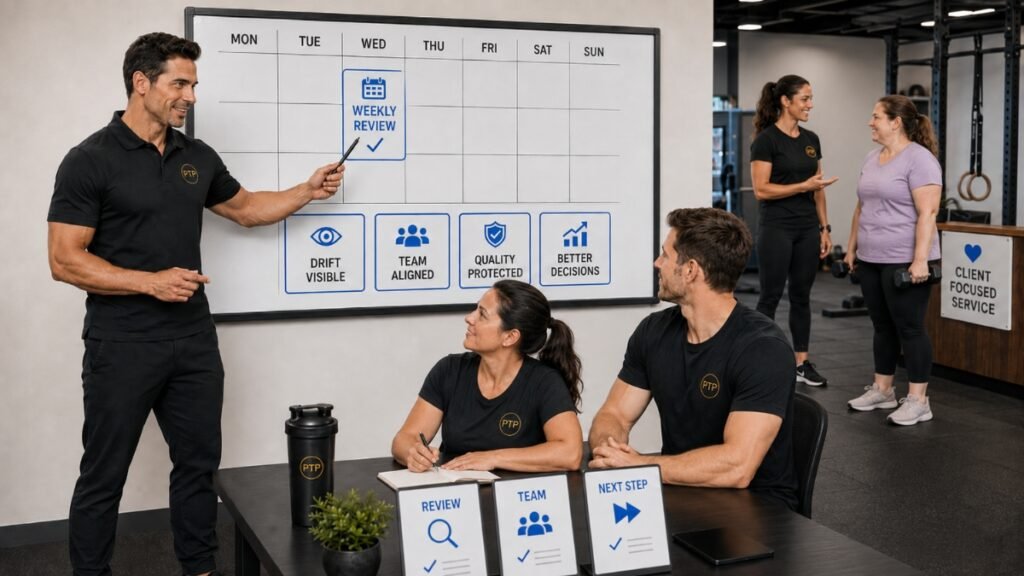
Personal training studio owner leading a weekly operating rhythm review with staff while a trainer supports a client in the background

Operating Rhythm for Personal Trainers

A personal training business does not stay controlled because the owner keeps everything in their head. It stays controlled because the right things are reviewed at the right time. That is what operating rhythm means. Operating rhythm is the recurring pattern of review, action, and follow-up that keeps the business from drifting. Without rhythm, the […]

Operating Rhythm for Personal Trainers Read More »

, , , , ,
Heroics versus systems in a personal training business, showing chaos on one side and organized studio systems on the other

Systems, Not Heroics for Personal Trainers

A personal training business can look successful while still depending far too much on one person. The owner remembers the details. The owner fixes the problems. The owner answers every staff question. The owner saves the session, saves the client, saves the schedule, and saves the day. That may feel like commitment. But it is

Systems, Not Heroics for Personal Trainers Read More »

, , , ,
Personal trainer holding a clipboard, representing a client journey SOP and a repeatable intake process from lead to 6 weeks

Client Journey SOP, From Lead to 6 Weeks

Most personal trainers don’t lose clients because they lack coaching skill. They lose them because the client experience is inconsistent. A simple client journey SOP fixes that. It turns chaos into a repeatable workflow, improves conversions, and makes retention predictable. This is the backbone of a real personal training business. 📌 Key Takeaways 🧭 Who

Client Journey SOP, From Lead to 6 Weeks Read More »

, , ,
Hand stacking wooden blocks, representing the 6-week foundation phase built step by step for a personal training business

The 6-Week Foundation Phase

Most personal trainers lose clients in the first 30–60 days, not because the training is “wrong,” but because the first phase has no structure. A 6-week foundation phase fixes that. It gives the client early wins, builds routine, and makes the next step obvious. This is the simplest way to turn a personal training business

The 6-Week Foundation Phase Read More »

, , , , ,
Hands holding three human figure icons, representing client retention and long-term relationships in a personal training studio

Why Deconditioned Clients Retain Longer, and Why That Changes Your Studio Math

Most studios chase more leads when the real profit lever is retention. When a studio is built for the deconditioned market, clients stay longer because the service matches real life, the process feels safe, and progress is measurable. Retention is not a “nice to have.” It is the business model. 📌 Key Takeaways 🧭 Who

Why Deconditioned Clients Retain Longer, and Why That Changes Your Studio Math Read More »

, , , , , ,
Blood pressure monitor during a simple client assessment in a personal training studio

Why Assessments Create Safety, Trust, and Higher Conversions

Most studios try to sell training before they earn trust. A simple assessment flips the order. It makes the first visit feel safe, professional, and structured, and it turns “I’m not sure” into “this feels doable.” 📌 Key Takeaways 🧭 Who this is for This is for studio owners and trainers who want higher consult

Why Assessments Create Safety, Trust, and Higher Conversions Read More »

, , , , , ,
Scroll to Top