
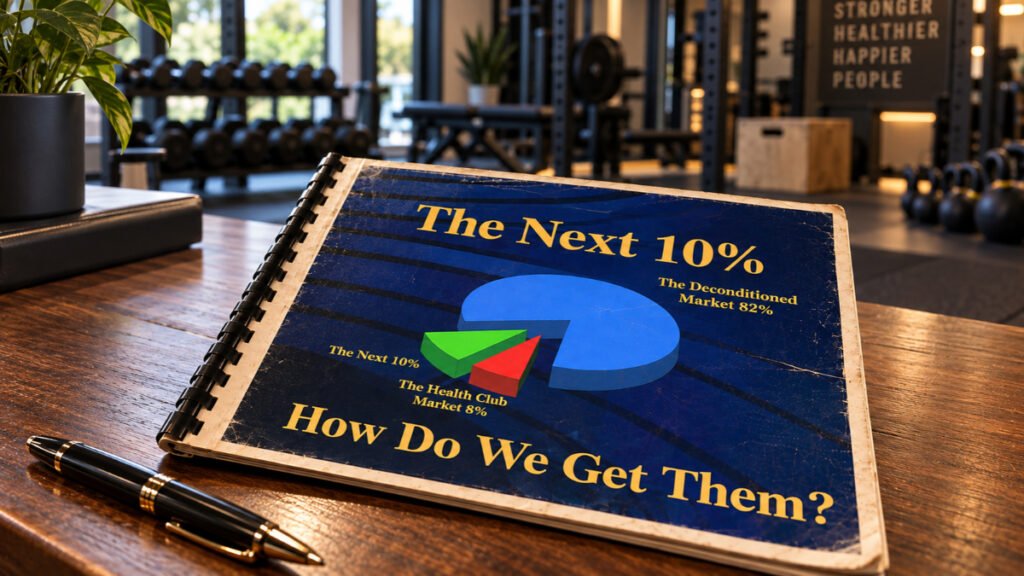
In 1999, I stood in front of the Nautilus sales team and told them the fitness industry was concentrating on the wrong market.
Health clubs, according to the figures I presented at the time, were reaching approximately 8% of the population.
The bigger opportunity was everyone else.
The people who wanted to improve their health but did not want to join a traditional gym.
And the important part was understanding why.
I identified three barriers:
Intimidation.
Lack of results.
Time.
Then I described the type of business that could remove those barriers.
Small.
Private.
Results-driven.
One-to-one.
Time-efficient.
Approximately 1,500 to 5,000 square feet, serving a few hundred clients rather than thousands of gym members.
At the time, I called it a Lifestyle Center because the personal training studio was not yet a clearly established business category.
Today, that category is everywhere.
There are independent studios operating on the model.
There are national franchise systems selling versions of it.
And many of the messages used to sell those studios today address the same three problems that were sitting in that 1999 presentation.
The interesting part is not that the prediction was perfect.
It is that the market opportunity was already visible more than 25 years ago.
And much of the underlying business logic has barely changed.
Prefer to watch? Here’s the full YouTube breakdown.
📌 Key Takeaways
- The traditional health club model was designed for a relatively small part of the population.
- The much larger opportunity was people who wanted results but disliked the traditional gym environment.
- The 1999 presentation identified three major barriers: intimidation, lack of results, and perceived time commitment.
- A small private personal training studio could address all three.
- The proposed studio footprint was only 1,500 to 5,000 square feet.
- The 1999 model targeted approximately 150 to 250 active clients.
- Two real operators in the presentation were already demonstrating that people would pay substantially more for a results-based personal training service.
- The studio model was positioned around value and results rather than low-cost access.
- The category eventually developed very closely to the structure described in the presentation.
- What changed most was not the business model. It was the cost of buying access to it through a franchise.
🧭 Who This Is For
This article is for personal trainers and prospective studio owners trying to understand where the real market opportunity exists.
It is especially relevant if you are:
- thinking about opening a personal training studio;
- deciding who the studio should be designed for;
- competing primarily for people who already use gyms;
- considering a personal training franchise;
- trying to differentiate an independent studio;
- or wondering whether the deconditioned market is really large enough to build a business around.
The central question is not:
How do we get more gym members?
It is:
What would we build for the people who never wanted to become gym members in the first place?
That is a very different business question.
⚠️ The Traditional Model Was Solving the Wrong Problem
In the 1999 presentation, the health club model was built around volume.
The figures I presented described approximately:
15,000 health clubs in the United States
with an average of around:
1,500 members
generating approximately:
$640,000 in annual revenue
with payroll around:
40%
The exact industry numbers belong to that period.
The business principle is more important.
A health club sells access.
The economics become stronger when many people buy memberships and relatively few occupy the facility at the same time.
Personal training operates differently.
Personal training sells:
- appointments;
- supervision;
- accountability;
- professional guidance;
- progression;
- and results.
The client is supposed to show up.
That difference creates an entirely different operating model.
✅ The Opportunity Was the Market Outside the Gym
One of the objections to the 92% argument was obvious.
Perhaps those people simply did not want to exercise.
The 1999 deck included evidence suggesting otherwise.
Between 1987 and 1995, the figures presented showed home exercise equipment sales growing almost 100%, while health club memberships increased by approximately 38%.
People were spending money to exercise.
They just did not necessarily want to do it inside a traditional gym.
That suggested the problem was not demand for exercise.
The problem was the environment and the way the service was being delivered.
That led to three specific barriers.
1️⃣ Barrier One: Intimidation
Traditional gyms have historically been very good at attracting people who already feel comfortable in gyms.
That creates a problem.
The people who most need help may be the people least comfortable walking through the door.
They may be:
- significantly deconditioned;
- overweight;
- inexperienced;
- embarrassed;
- worried about being watched;
- unsure how equipment works;
- or concerned they will look out of place.
This is not necessarily something better advertising can solve.
Because the objection may be the actual environment.
If the prospect believes everyone inside already looks fitter, stronger, younger, or more experienced, the building itself becomes a barrier.
A private personal training studio changes that.
It can deliberately feel:
- quieter;
- more controlled;
- more private;
- more professional;
- and less intimidating.
That is not simply interior design.
It is positioning.
2️⃣ Barrier Two: Lack of Results
The second barrier in the 1999 presentation was results.
The deck stated that approximately 80% of new health club members did not last six weeks.
Again, that is a historical figure from the presentation, not a claim about today’s industry.
But the underlying problem remains recognizable.
Access is not the same thing as guidance.
A person can have access to:
- hundreds of machines;
- free weights;
- cardio equipment;
- group classes;
- and a large facility;
and still have no clear idea what to do.
A supervised personal training model changes the product.
Instead of selling access, the business sells a structured process.
The client receives:
- an assessment;
- a clear starting point;
- supervised sessions;
- progression;
- tracking;
- reassessment;
- and accountability.
That gives the client something more valuable than equipment.
It gives them a path.
3️⃣ Barrier Three: Time
The third barrier was perceived time commitment.
Many people associate exercise with spending hours every week inside a gym.
For enthusiasts, that may be perfectly acceptable.
For a deconditioned person balancing:
- work;
- family;
- children;
- commuting;
- and everyday responsibilities;
it can become another reason never to begin.
The personal training studio offered another answer.
Scheduled appointments.
Efficient supervised strength training.
A clear plan.
The client did not need to become a gym enthusiast.
They needed to arrive for the appointment and follow the program.
This is one reason the 30-minute personal training model became so powerful.
It reduced another barrier.
4️⃣ Build a Different Business for a Different Customer
Once those three problems were identified, the solution became fairly straightforward.
Do not try to make the traditional gym slightly more attractive to someone who already dislikes gyms.
Build something different.
The 1999 deck proposed a business that was:
Non-intimidating
Private
Results-driven
One-to-one
Time-efficient
I called it a Lifestyle Center.
Today we would simply recognize it as a dedicated personal training studio.
The important part is that this was not merely a smaller gym.
The business model was different.
The customer was different.
The service was different.
The value proposition was different.
And the economics were different.
5️⃣ The 1999 Studio Specification
The proposed business was surprisingly small.
The presentation specified approximately:
1,500 to 5,000 square feet
serving:
150 to 250 clients
At the time, the modeled client value was approximately:
$53 to $82 per week
with projected annual revenue ranging from:
$413,400 to more than $1 million
and payroll around:
45%
Those were the figures shown in the 1999 presentation.
What stands out today is how familiar the basic footprint looks.
A studio does not require tens of thousands of square feet.
It does not require thousands of members.
It requires enough space to deliver personal training efficiently to a few hundred committed clients.
That is remarkably close to the small-studio economics we still model today.
6️⃣ The Health Club and Studio Models Were Fundamentally Different
The comparison slide in the original presentation put the two models side by side.
Using the figures and assumptions presented in 1999:
| 1999 Comparison | Health Club | Lifestyle Center |
|---|---|---|
| Target market | 8% | 92% |
| Growth | Stagnant | Astronomical |
| Competition | High | Very little |
| Facility size | 20,000 to 50,000 sq ft | 1,500 to 5,000 sq ft |
| Profit margin | 6% to 30% | 25% to 60% |
These are historical presentation figures, not current industry benchmarks.
But look at the strategic distinction.
The traditional model needed:
- more space;
- more members;
- lower individual client value;
- and more volume.
The personal training model needed:
- less space;
- fewer clients;
- higher client value;
- and deeper service.
The smaller business did not need to beat the gym at being a gym.
It needed to stop competing on the gym’s terms.
7️⃣ Champions Gym Proved the Market Could Pay
The deck also included real-world operating examples.
One was Champions Gym in Dayton, Ohio.
In 1995, they added personal training packages aimed at this market using a program I built.
The health club did not need to stop selling memberships.
Instead, it added a higher-value service for people who wanted more help.
Personal training revenue increased from approximately:
$14,000 per month
to:
$25,000 per month
within the first 30 days.
By the time of the 1999 presentation, the business had expanded into three standalone personal training centers alongside the original gym.
That was important evidence.
The opportunity was not theoretical.
People were already paying for a different service.
8️⃣ Wellness Works Stopped Competing on Price
The second example was Wellness Works in Tallahassee, Florida.
A new 50,000-square-foot club was preparing to open nearby.
The obvious reaction would have been to compete.
Lower the membership price.
Add promotions.
Discount harder.
Instead, the business went in the opposite direction.
They launched a six-week personal training program priced at:
$600
while competitors were fighting for memberships below:
$19 per month
The result was record revenue months, more than $10,000 above the previous best.
They did not beat the larger facility on price.
They changed the product.
That is one of the most important positioning lessons in the entire presentation.
You do not have to win a price war if you stop selling the same thing.
9️⃣ The Personal Training Studio Category Eventually Arrived
Look at the dedicated personal training studio category today.
Many successful operators emphasize:
- private or semi-private environments;
- short scheduled appointments;
- supervised strength training;
- measurable results;
- accountability;
- and a more comfortable alternative to a traditional gym.
The physical footprints are frequently much smaller than traditional health clubs.
In other words, the category eventually moved toward many of the same characteristics described in the 1999 presentation.
That does not mean somebody found the deck and copied it.
I am not making that claim.
The point is more useful than that.
The market conditions were already visible.
The underserved customer already existed.
The barriers were identifiable.
And once someone built a business around removing those barriers, the economics worked.
🔟 The Biggest Change Was the Price of Entry
In 1999, the route into this business was straightforward.
Build it.
Find a suitable commercial space.
Buy the equipment.
Develop the systems.
Market the offer.
Serve the clients.
That is how the independent studios in these examples were built.
Today there is another option.
Buy a franchise.
Published personal training franchise summaries can show total initial investments ranging from roughly:
$260,000 to $880,000
depending on the brand and format.
Then ongoing percentages of gross revenue may continue under the franchise agreement.
That does not mean franchises do not provide value.
They can provide:
- systems;
- brand;
- training;
- operating procedures;
- marketing guidance;
- supplier relationships;
- and support.
But the underlying studio opportunity existed before the franchise category.
And the independent route still exists now.
That is why anyone considering a franchise should compare both paths.
Not simply:
Which franchise should I buy?
But:
Do I need to buy a franchise at all?
🎯 What This Means for a Studio Owner Today
The most important lesson from the 1999 presentation is not historical.
It is strategic.
Before deciding:
- what equipment to buy;
- what building to lease;
- how much to charge;
- what advertising to run;
- or how large the studio should be;
decide who the business is for.
If you build for the same person every conventional gym is chasing, you enter a crowded market.
If you build around the person who does not want the conventional gym experience, the positioning changes completely.
Ask:
- Who is currently excluded by the traditional model?
- What makes them uncomfortable about existing options?
- What results do they actually want?
- What amount of time are they realistically willing to commit?
- What environment would make them feel safe enough to begin?
- What level of supervision would increase their chance of succeeding?
- What would they pay for that outcome?
The deconditioned market does not need another gym.
It needs a business designed around why they avoided the gym in the first place.
The Key Takeaway
The 1999 presentation was built around a simple idea.
The largest opportunity in the fitness industry was not necessarily the people already using gyms.
It was everyone else.
The people who wanted to improve their health but were blocked by:
intimidation
lack of results
and
time
The proposed answer was a small, private, results-driven personal training business.
Approximately 1,500 to 5,000 square feet.
A few hundred clients.
High-touch service.
Higher client value.
A completely different experience from the traditional health club.
That category now exists.
The business opportunity did not disappear.
If anything, it became easier to see.
The deconditioned market was the opportunity in 1999. It is still the opportunity today.
➡️ Next Step
If you want to build an independent personal training studio around this market rather than buy somebody else’s version of it, the Personal Training Profits Academy includes complete studio models ranging from a single-trainer studio through to a larger commercial operation.
The Academy covers:
- costs;
- floor plans;
- positioning;
- staffing;
- systems;
- operating numbers;
- and what tends to go wrong at each stage.
Get started in the academy here: Currently Sold Out
About the Author

Paul Barclay has been building supervised personal training studios since 1991, in Australia, the Middle East and the United States. That includes a Perth centre doing over $1,000,000 a year that expanded from one location to four, an Ohio studio franchise-ready by 2000, a Dallas turnaround that doubled monthly revenue, and an 850 square foot room that produced six figures a year for a decade.
In 1996 he presented a model to Nautilus arguing that three barriers keep most people out of gyms. The industry solved two of them and built a multi-billion dollar franchise category on the back of it. The third is still open.
Personal Training Profits exists to help people open studios they own outright, without a franchise fee and without a royalty in perpetuity.








Please help us by sharing on your favorite Social Media