
retention

Laptop on a desk displaying “Time for Review,” representing a 15-minute weekly owner meeting and simple scorecard check-in

Weekly Review, The 15-Minute Owner Meeting

Most personal trainers don’t need more ideas. They need a simple operating rhythm so the business stops guessing and starts improving on purpose. A 15-minute weekly owner meeting does that. It forces clarity, keeps the business honest, and prevents the “busy but unstable” cycle. 📌 Key Takeaways 🧭 Who this is for This is for […]

Weekly Review, The 15-Minute Owner Meeting Read More »

, , , , ,
Personal trainer holding a clipboard, representing a client journey SOP and a repeatable intake process from lead to 6 weeks

Client Journey SOP, From Lead to 6 Weeks

Most personal trainers don’t lose clients because they lack coaching skill. They lose them because the client experience is inconsistent. A simple client journey SOP fixes that. It turns chaos into a repeatable workflow, improves conversions, and makes retention predictable. This is the backbone of a real personal training business. 📌 Key Takeaways 🧭 Who

Client Journey SOP, From Lead to 6 Weeks Read More »

, , , , ,
Hand stacking wooden blocks, representing the 6-week foundation phase built step by step for a personal training business

The 6-Week Foundation Phase

Most personal trainers lose clients in the first 30–60 days, not because the training is “wrong,” but because the first phase has no structure. A 6-week foundation phase fixes that. It gives the client early wins, builds routine, and makes the next step obvious. This is the simplest way to turn a personal training business

The 6-Week Foundation Phase Read More »

, , , , ,
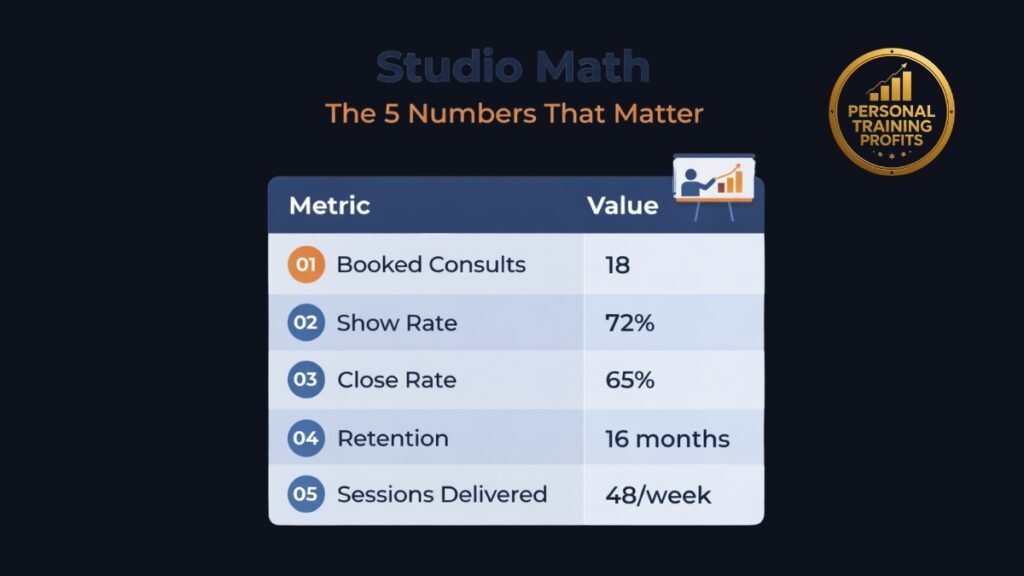
Studio math graphic showing the five numbers that matter, booked consults, show rate, close rate, retention, and sessions delivered

Studio Math, The 5 Numbers That Matter

Most personal trainers try to grow by working harder, posting more, or chasing more leads. That creates a busy calendar, but it does not create a predictable personal training business. Predictable growth comes from simple math. Not complicated accounting, just a small set of numbers that tell you what is working and what to fix

Studio Math, The 5 Numbers That Matter Read More »

, , , , ,
Person reviewing lead tracking and conversion charts on a computer, representing personal training sales metrics

How to Increase Personal Training Sales

Most personal trainers don’t have a sales problem. They have a tracking problem. Nearly every lead source can work, TV, radio, direct mail, local print, partnerships, brochures, YouTube, and short-form reels. The studios that grow are not the ones that try every tactic. They are the ones who record the numbers, learn what works in

How to Increase Personal Training Sales Read More »

, , , , ,
Extinguished candle with smoke on a dark background, symbolizing personal trainer burnout

Why Personal Trainers Burn Out, and How Systems Fix It

Most trainer burnout is not caused by lack of passion. It is caused by a business model that depends on constant energy, constant selling, and constant improvisation. When the business runs on personality, the owner becomes the bottleneck, and the business becomes fragile. A business that runs on systems is different. It creates predictability for

Why Personal Trainers Burn Out, and How Systems Fix It Read More »

, , , , ,
Hands holding three human figure icons, representing client retention and long-term relationships in a personal training studio

Why Deconditioned Clients Retain Longer, and Why That Changes Your Studio Math

Most studios chase more leads when the real profit lever is retention. When a studio is built for the deconditioned market, clients stay longer because the service matches real life, the process feels safe, and progress is measurable. Retention is not a “nice to have.” It is the business model. 📌 Key Takeaways 🧭 Who

Why Deconditioned Clients Retain Longer, and Why That Changes Your Studio Math Read More »

, , , , , ,
Scroll to Top