
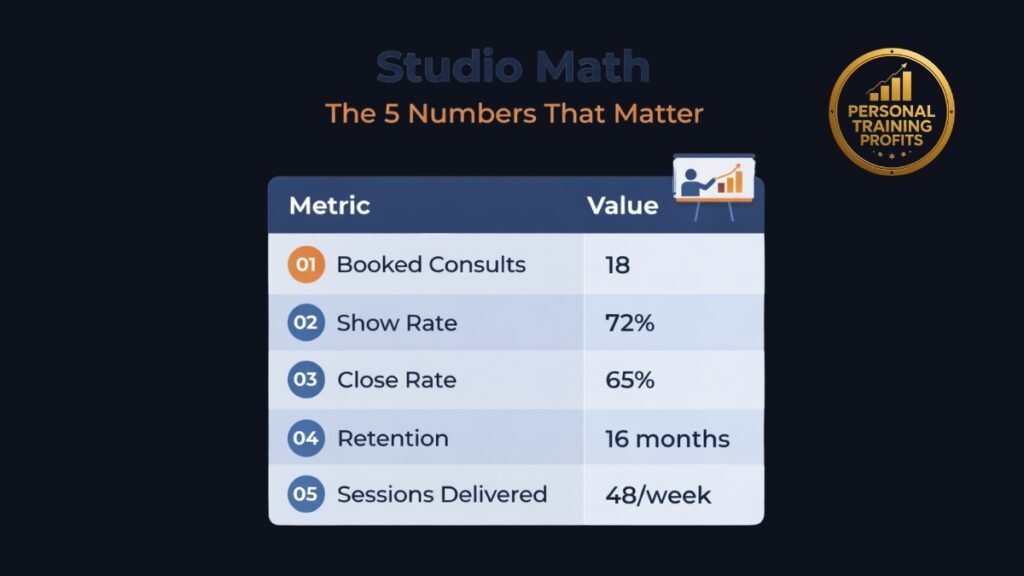
Most personal trainers try to grow by working harder, posting more, or chasing more leads. That creates a busy calendar, but it does not create a predictable personal training business.
Predictable growth comes from simple math. Not complicated accounting, just a small set of numbers that tell you what is working and what to fix next. A million-dollar studio is not built by guessing, it is built by watching a small set of numbers and making deliberate changes to improve them.
📌 Key Takeaways
- The fastest way to grow is not “more ideas,” it’s improving the few numbers that drive revenue.
- Track conversion points, not vanity metrics: booked consults, show rate, close rate, retention, sessions delivered.
- A simple traffic-light dashboard makes numbers actionable, green, amber, red.
- Results and retention improve when the business runs on a 6-week foundation start and consistent progress reviews.
- Three sessions per week is the default recommendation for best results, and results drive retention.
🧭 Who this is for
This is for personal trainers and personal training business owners at any stage, employed, independent, in-home, online, or operating a studio, who want predictable revenue and fewer “busy but broke” months. The studio model is the destination for many trainers, but the math applies to any personal training business.
⚠️ The problem
Most trainers track the wrong things.
They track:
- followers
- likes
- website visits
- “inquiries”
But revenue is not built on attention. It is built on conversion points and retention. Book 1 of our Profit Engine series makes this clear: revenue is the outcome, you need to track the inputs and conversion points that drive it.
If you do not track the right numbers, you will:
- spend money on marketing when the real issue is the consult process
- blame lead flow when the real issue is show rate
- assume clients are “flaky” when the real issue is retention structure
- stay capped because you never know what lever to pull
✅ The solution
Use “studio math” as a management tool, even if you are not in a studio yet.
Track the five numbers that actually drive a personal training business:
- booked consults
- show rate
- close rate
- retention
- sessions delivered
Then review them weekly, use traffic lights, and fix only one lever at a time.
That’s how metrics become action, not anxiety.
🧱 The framework: The 5 numbers that matter
1) Booked consults (not inquiries)
A lead is not a lead until it books a consult.
Book 1 calls this out as a core conversion point: consult or assessment bookings show whether inquiry handling and messaging are working.
Track:
- inquiries received
- consults booked
- booking rate = consults booked ÷ inquiries
If booking rate is low, fix:
- speed to lead
- clarity of your next step
- your client-friendly messaging
- your follow-up routine
This is why your messaging posts matter. Messaging is not “branding,” it’s conversion.
2) Consult show rate (the hidden sales lever)
Booked consults are useless if people do not show up.
Book 2 even lists show rate as a key performance metric for the sales or enrollment function.
Track:
- consults booked
- consults attended
- show rate = attended ÷ booked
If show rate is low, fix:
- confirmation messages
- “what to expect” scripts
- reminders
- easy rescheduling rules
This is one of the fastest wins in any personal training business because it increases real sales conversations without buying more leads.
3) Close rate (consult-to-enrollment conversion)
This is the core decision point.
Book 1 frames the consult as the main decision point in the model, and you want a clear measurement of how many people start after sitting down with you.
Track:
- consults attended
- enrollments
- close rate = enrollments ÷ consults attended
If close rate is low, fix:
- consult structure and clarity
- one clear recommendation
- confidence-based, no-pressure close
- decision summary sheet or take-home plan
Book 2 gives a practical example of how one number points to the solution. If leads and bookings are steady but conversion is weak, don’t spend more on ads. Fix the assessment script, the program recommendation, and the pricing presentation.
4) Retention (length of stay)
Retention is the profit multiplier.
Book 1 puts “average length of stay” on the minimum list because this model is built around long-term relationships, not short challenges.
Track:
- average length of stay (months)
- attrition rate (how many leave per month)
- renewals and continuation rate
If retention is low, fix the system, not the client:
- 6-week foundation phase with clear milestones
- planned progress reviews and check-ins
- re-assessments as retention anchors
Book 3 calls progress reviews “retention anchors” and explains that continuation should feel like a path, not a transaction.
Retention improves when clients can see:
- what improved
- why it matters
- what comes next
- why staying with the process makes sense
5) Sessions delivered (and capacity utilization)
This is the operational reality check.
Book 2’s simple dashboard includes sessions delivered and capacity utilization, because you need to know if you are under-booked, full, or at the point where adding staff becomes the next move.
Track:
- sessions delivered per week
- available time slots
- capacity utilization = sessions delivered ÷ available slots
This matters because:
- if capacity is low, you don’t need more systems, you need more booked consults and better conversion
- if capacity is high, you need operations, staffing, and scheduling systems to scale without chaos
Book 1 also frames capacity usage as a key number to know when to add a trainer or extend hours.
🔧 Tools and templates you can copy
1) The 5-number scorecard (one page)
Create a simple sheet with:
Client Flow
- Consults booked
- Show rate
- Close rate
Client Base
- Active clients
- Retention or average length of stay
Operations
- Sessions delivered
- Capacity utilization
This mirrors the simple dashboard layout described in Book 2.
2) Traffic-light dashboard (green, amber, red)
Book 2 recommends a traffic-light dashboard because it turns raw data into a management signal.
Set thresholds for each number:
- Green: on track
- Amber: slipping
- Red: action now
Do not aim for perfection. Aim for fast visibility.
3) Weekly review rhythm (15 minutes)
Numbers only help if they are reviewed consistently.
Every week, review:
- what moved up
- what slipped
- what one lever you will fix this week
One lever only. That prevents overwhelm.
4) The “one metric” rule
Book 2’s example is the principle:
If marketing is steady but revenue is not growing, find the weak conversion point and fix the script or process, not the ad spend.
🧱 How these numbers connect to the model you’re building
When you combine:
- a clear flagship program structure (built around consistent weekly sessions)
- client-friendly messaging for the non-gym majority
- a consult-first path
- assessments and re-assessments that show progress
- a simple dashboard and review rhythm
You stop relying on hustle and start running a business.
This is also how the studio model becomes scalable: clear roles, clean handoffs, and performance metrics that make management practical.
➡️ Next step
If you want to install this properly, the playbooks now work together as a complete system.
- Playbook 2 expands the operating system: roles, SOPs, checklists, operating rhythm, and the dashboard that makes these numbers visible.
- Playbook 3 expands the profit engine: lead flow, consult structure, conversion, retention, referrals, and campaigns that keep the business fed.
And for the Academy, this is exactly where a simple Skool scorecard becomes powerful: one page, five numbers, weekly review, and a clear “fix this next” path. Join our FREE academy here








Please help us by sharing on your favorite Social Media