
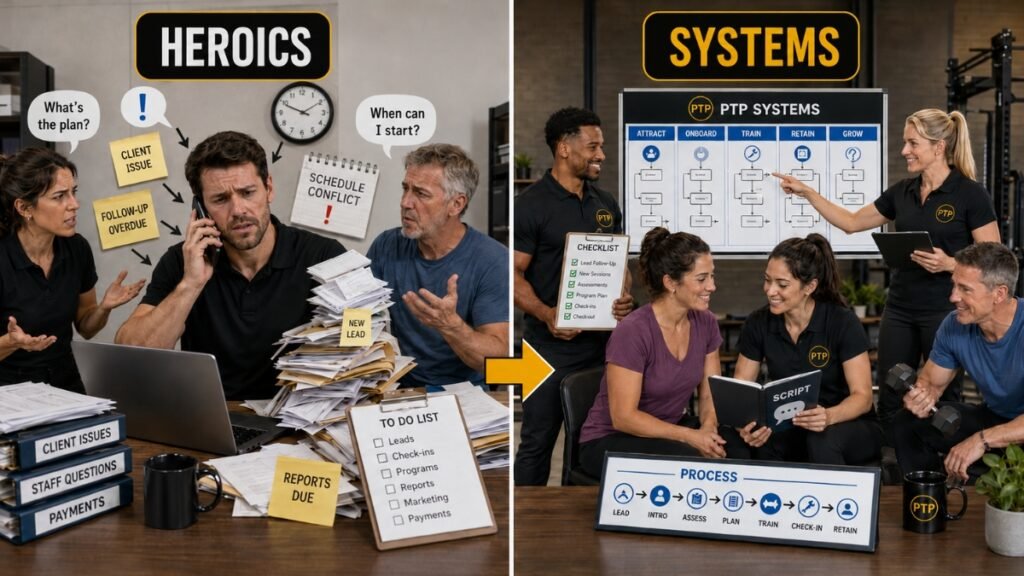
A personal training business can look successful while still depending far too much on one person.
The owner remembers the details.
The owner fixes the problems.
The owner answers every staff question.
The owner saves the session, saves the client, saves the schedule, and saves the day.
That may feel like commitment.
But it is also the beginning of a fragile business.
A business that depends on the owner’s memory, stamina, personality, and rescue work is not really running on systems.
It is running on heroics.
Heroics may get a personal training business started.
They cannot carry it forever.
The goal is not to remove care, personality, or professional judgment.
The goal is to remove randomness.
Systems do not remove personalization.
Systems remove randomness.
They turn repeated work into a clear operating method that other people can understand, follow, train, and improve.
Prefer to watch? Here’s the full YouTube breakdown.
📌 Key Takeaways
- Heroics create owner dependency.
- A busy studio is not always a systemized studio.
- A system is more than an SOP or checklist sitting in a folder.
- A useful system includes a sequence, checklist, script, and decision rules.
- Systems do not make personal training robotic.
- Systems protect standards, safety, communication, progression, and follow-through.
- Personalization works better when the foundation is consistent.
- Staff become easier to train when the method is documented.
- Clients feel more confident when the studio experience is clear and reliable.
- Start by documenting one repeated process, not the whole business.
🧭 Who this is for
This article is for personal trainers, studio owners, and team leaders who:
- feel like everything depends on them;
- answer the same staff questions over and over;
- keep solving the same client problems manually;
- struggle to step away from the business;
- have clients who only want the owner;
- have staff who lack confidence making decisions;
- deliver good service, but inconsistently;
- want to grow without lowering the standard;
- or know the business needs systems but are unsure where to start.
If the business only works when the owner is everywhere at once, the business is not yet systemized.
It may be busy.
It may be profitable.
It may have loyal clients.
But it is still fragile.
⚠️ The problem
The heroic owner trap usually begins innocently.
The business is small.
The owner is capable.
Clients trust the owner.
Staff look to the owner for direction.
At first, this feels like leadership.
If a client has a question, the owner answers it.
If a trainer is unsure, the owner decides.
If a process breaks, the owner fixes it.
If a client is unhappy, the owner steps in.
The business keeps moving, but only because one person is carrying too much of it in their head.
That is not a stable operating model.
It is dependency disguised as dedication.
Over time, the owner becomes the system.
And when the owner becomes the system, the business cannot reliably run without the owner.
✅ The solution
Replace heroics with systems.
A system is not just “being organized.”
It is not just a document.
It is not simply telling staff to “deliver great service.”
A system is a repeatable method that produces a consistent result.
Inside a personal training business, a useful system usually includes four parts:
- Sequence: what happens first, second, third, and next.
- Checklist: what must not be missed.
- Script: what needs to be communicated consistently.
- Decision rules: what staff should do when common situations happen.
This four-part framework turns repeated work into something trainable.
It reduces owner overload.
It improves staff confidence.
It makes the client experience more reliable.
And it allows the business to deliver personal care without relying on constant improvisation.
1️⃣ Heroics create dependency
Heroics can solve today’s problem while creating tomorrow’s dependency.
When clients believe the owner is the only person who can help them, they attach to the personality instead of the process.
When staff believe every decision has to go back to the owner, they stop becoming confident operators.
When the owner keeps fixing the same problems, the business never learns.
This creates a cycle.
The owner feels essential.
The team stays uncertain.
Clients resist handoffs.
The studio becomes harder to grow.
The problem is not that the owner cares too much.
The problem is that care has not been converted into a repeatable method.
A personal training business cannot depend forever on one person’s memory, energy, and ability to rescue every ordinary situation.
That is not a business model.
That is a bottleneck.
2️⃣ Busy does not mean systemized
Busy can be misleading.
A studio may have clients coming in every day.
The schedule may look full.
The owner may feel constantly needed.
Revenue may be coming in.
From the outside, that can look like success.
But busy does not mean systemized.
A studio can be busy and still be:
- disorganized;
- owner-dependent;
- inconsistent;
- difficult to train around;
- difficult to step away from;
- difficult to scale;
- and fragile under pressure.
The question is not only whether the studio is busy.
The better question is whether the studio can repeat the same standard without the owner constantly holding it together.
If every day depends on memory, mood, instinct, and rescue work, the business is still fragile.
A business that only works when the owner is everywhere at once is not yet running on systems.
3️⃣ A real system is more than a checklist
A checklist can be useful.
But a checklist alone is not the whole system.
A real system gives people a clear method for producing a consistent result.
That method usually includes:
- a sequence;
- a checklist;
- a script;
- and decision rules.
Each part does something different.
The sequence tells people the order of events.
The checklist protects important details.
The script protects communication.
The decision rules reduce uncertainty when common situations appear.
When these four parts are clear, the business becomes easier to run because fewer things depend on memory, mood, or guesswork.
A system does not have to be complicated.
It has to be clear enough that another trained person can follow it.
4️⃣ Sequence creates the path
Sequence means:
What happens first, second, third, and next?
Without a sequence, the client journey becomes random.
One client gets a proper intake.
Another client gets a quick chat.
One client receives an assessment.
Another is pushed into sessions before the trainer understands the starting point.
One client gets a reassessment.
Another simply drifts along without a clear next phase.
A systemized business defines the path.
For example, a new prospect may move through:
- Enquiry
- Consultation
- Initial assessment
- Program start
- Progress tracking
- Reassessment
- Next phase
That does not mean every person receives identical coaching.
It means every person moves through a professional structure.
Sequence creates clarity before the details are personalized.
5️⃣ Checklists protect the standard
A checklist answers:
What must not be missed?
Checklists protect the standard when the day gets busy.
This matters because most breakdowns in a small studio are not dramatic.
They are small missed details.
A client note is not checked.
A follow-up is forgotten.
A measurement is skipped.
A staff member opens the studio differently from the last person.
A reassessment is discussed casually instead of completed properly.
A cancellation is handled one way on Monday and another way on Thursday.
Checklists reduce that randomness.
They do not make staff less professional.
They help staff act professionally under pressure.
A checklist is not there because people are careless.
It is there because memory is not a reliable operating system.
Useful checklist areas include:
- opening tasks;
- new enquiry response;
- client intake;
- initial assessment;
- session notes;
- follow-up;
- reassessments;
- missed appointment follow-up;
- and staff onboarding.
A checklist makes the expected standard visible.
6️⃣ Scripts protect communication
A script does not mean sounding fake.
It means the important message is not left to chance.
In a personal training business, certain conversations matter too much to improvise every time.
How do you explain the first step?
How do you explain the assessment?
How do you set expectations around attendance?
How do you explain the next phase?
How do you follow up with a new lead?
How do you respond when someone says they need to think about it?
How do you explain a reassessment so the client understands its purpose?
The purpose of a script is not to remove personality.
It is to protect clarity.
A good staff member can still sound natural, warm, and personal.
The script simply makes sure the core message is consistent.
Scripts are especially useful for:
- enquiry replies;
- consultation booking;
- initial consultations;
- assessment explanations;
- attendance expectations;
- program recommendations;
- reassessments;
- follow-up;
- and retention conversations.
The words do not need to be robotic.
The message needs to be reliable.
7️⃣ Decision rules reduce owner interruption
Decision rules answer:
What should staff do when this happens?
Without decision rules, every small situation becomes a question for the owner.
What do we do if a client cancels late?
What do we do if a client reports pain?
What do we do if someone misses two sessions in a row?
What do we do if a trainer is sick?
What do we do if a client is not progressing?
What do we do if the schedule has gaps?
If the answer is always, “Ask the owner,” the business is still owner-dependent.
Decision rules give staff a clear first response.
They do not remove judgment.
They give judgment a safer starting point.
Examples include:
- late cancellation process;
- missed appointment follow-up;
- pain report response;
- poor attendance response;
- reassessment escalation;
- trainer absence plan;
- handoff rules;
- client concern process;
- and when to escalate to the owner.
Decision rules turn repeated situations into a manageable operating method.
They reduce panic.
They build staff confidence.
They stop ordinary problems from becoming daily fires.
8️⃣ Systems remove randomness, not personalization
This is the key belief shift.
Systems do not remove personalization.
Systems remove randomness.
Randomness shows up when different clients receive different standards for no good reason.
Randomness shows up when one trainer handles a situation one way and another trainer handles it completely differently.
Randomness shows up when the owner has to answer the same question again and again.
Randomness shows up when the client experience depends too much on who happened to be working that day.
Systems reduce that.
They make the business more predictable.
They make the client experience more reliable.
They make staff training easier.
They reduce the number of small decisions that drain the owner every week.
A good system does not force every client into the same coaching style, conversation, or program detail.
It protects the standard around the client.
The trainer can still adjust the session.
The trainer can still respond to the person.
The trainer can still choose the right coaching cue.
The trainer can still build a real relationship.
But the client is no longer left at the mercy of random delivery.
Personalization works better when the foundation is consistent.
9️⃣ Same standard, personal delivery
A system-driven studio should have the same standard with personal delivery.
That is the balance.
The intake should be consistent.
The assessment should be consistent.
The notes should be completed.
The program structure should follow the studio method.
The reassessment should happen when it is supposed to happen.
The follow-up should not depend on whether someone remembered.
Inside that standard, the trainer can still personalize.
They can adjust:
- tone;
- pace;
- exercise selection;
- coaching cues;
- explanations;
- encouragement;
- session flow;
- and relationship style.
The system creates the frame.
The trainer brings the human skill inside the frame.
That is not robotic.
It is professional.
Clients do not usually ask whether a studio has systems.
But they feel the difference.
They feel it when the session starts smoothly.
They feel it when the trainer knows the plan.
They feel it when progress is tracked.
They feel it when follow-up happens without them having to chase.
They feel it when a problem is handled calmly and consistently.
For deconditioned clients, this matters even more.
Many are already uncertain, nervous, or worried about failing again.
A reliable client experience helps them relax into the process.
It makes the studio feel safer.
It builds trust.
And trust is one of the reasons people stay.
🔟 Staff training becomes easier
A business without systems needs unicorns.
It needs people who somehow already know how the owner wants everything done.
They need to communicate like the owner.
Coach like the owner.
Make decisions like the owner.
Remember the same details as the owner.
That is not realistic.
A system-driven studio can hire capable people and train them into the standard.
The staff member learns:
- what to do;
- what to say;
- what to check;
- when to escalate;
- how to deliver the standard;
- and how to handle common situations.
That does not make every trainer identical.
It gives every trainer a clear operating base.
Systems turn staff training from guesswork into a repeatable process.
This also reduces owner overload.
Owner overload usually comes from too many repeated decisions.
Not just one big decision.
Hundreds of small ones.
What should we say to this prospect?
How should we handle this cancellation?
What should this trainer do next?
Who followed up?
What happens with this client?
Where is the note?
When every small question returns to the owner, the business becomes mentally heavy.
Systems reduce that load.
They turn repeated decisions into documented sequences, checklists, scripts, and rules.
This does not mean the owner never leads.
It means the owner is no longer required to personally rescue every ordinary situation.
⚙️ Examples of personal training studio systems
Systems show up across the whole studio.
They can begin with the new enquiry response.
How quickly is the new lead contacted?
What is said?
What is the next step?
They can continue through the consultation booking process, initial assessment, program start, session delivery, progression tracking, reassessment, retention follow-up, and staff onboarding.
A studio can systemize:
- new enquiry response;
- consultation booking;
- first consultation;
- initial assessment;
- session opening;
- session delivery;
- progression tracking;
- reassessment;
- missed appointment follow-up;
- retention follow-up;
- referral process;
- staff onboarding;
- and problem handling.
This does not mean everything must be systemized at once.
That would overwhelm most owners.
The better approach is to choose one repeated process and document it properly.
Then choose the next one.
A system-driven studio is built layer by layer.
Assessment system example
The assessment is a useful example because it affects safety, trust, sales, programming, and retention.
Start with the sequence.
What happens before the appointment?
What happens when the client arrives?
What happens during the conversation, screening, measures, and exercise introduction?
Then build the checklist.
What must be completed every time?
Then write the script.
How is the assessment explained so the client understands it is a starting point, not a judgment?
Then define the decision rules.
What happens if there is a medical concern?
What happens if the client is very deconditioned?
What happens if the client is not ready for normal sessions yet?
That is how an assessment becomes a system.
Session delivery system example
Session delivery also needs a system.
This does not mean every session is identical.
It means the session follows a professional structure.
The trainer checks in.
The warm-up prepares the client.
The main supervised work is protected.
Adjustments are made when needed.
Notes are recorded.
The next appointment is reinforced.
This helps the client feel guided from start to finish.
It also helps staff deliver a consistent experience across different days, trainers, and clients.
A studio that wants to grow cannot rely on each trainer inventing a different session style.
It needs a shared delivery standard that still allows intelligent personalization.
Problem-handling system example
Every studio has recurring problems.
The issue is whether the business handles them consistently.
A client cancels late.
A client misses a week.
A client reports pain.
A client stops progressing.
A trainer is absent.
The schedule gets messy.
In a heroic studio, each problem becomes a new emergency.
In a system-driven studio, common problems have first-response rules.
When this happens, do this first.
That simple idea prevents panic.
It also gives staff confidence.
They do not need to guess.
They do not need to wait for the owner every time.
They have a clear first step, and they know when to escalate.
🎯 This week’s action step
Do not try to document the whole business this week.
Choose one repeated process that currently creates friction.
Good starting points include:
- new enquiry response;
- consultation booking;
- first consultation;
- initial assessment;
- session opening;
- reassessment;
- missed appointment follow-up;
- retention follow-up;
- or new staff onboarding.
Then document that process using the four-part system framework.
1. Write the sequence
What happens first, second, third, and next?
2. Create the checklist
What must not be missed?
3. Write the key script
What needs to be communicated consistently?
4. Define the decision rules
What should staff do when common situations happen?
Do not make this theoretical.
Pick one process that would make the business easier to run if it became clearer.
If you need help, a useful Ask-a-Coach post might look like this:
Our missed appointment follow-up is inconsistent. I wrote the sequence, but need help creating the script and decision rules. What should we standardize first?
That is a much better question than:
We need better systems.
Better systems start with one repeated process.
Document one.
Train it.
Use it.
Improve it.
Then move to the next one.
The key takeaway
Systems do not make the studio robotic.
They make the standard repeatable.
Heroics can get a business started, but they cannot carry a business forever.
When everything depends on the owner’s memory, energy, and rescue work, the studio becomes fragile.
When the work is documented, trained, and repeated, the business becomes stronger.
Clients receive a more reliable experience.
Staff become easier to train.
The owner has fewer repeated decisions to carry.
And the studio becomes more stable, scalable, and valuable.
Heroics depend on one person.
Systems build a business.
Systems do not remove care. Systems remove randomness.
➡️ Next step
Where is your business actually leaking? The Personal Training Business Starter Kit includes a scorecard: five sections, 25 questions, scored out of 125. About ten minutes with a pen and you will know which part of the business is costing you money. → Get the free Starter Kit








Please help us by sharing on your favorite Social Media