
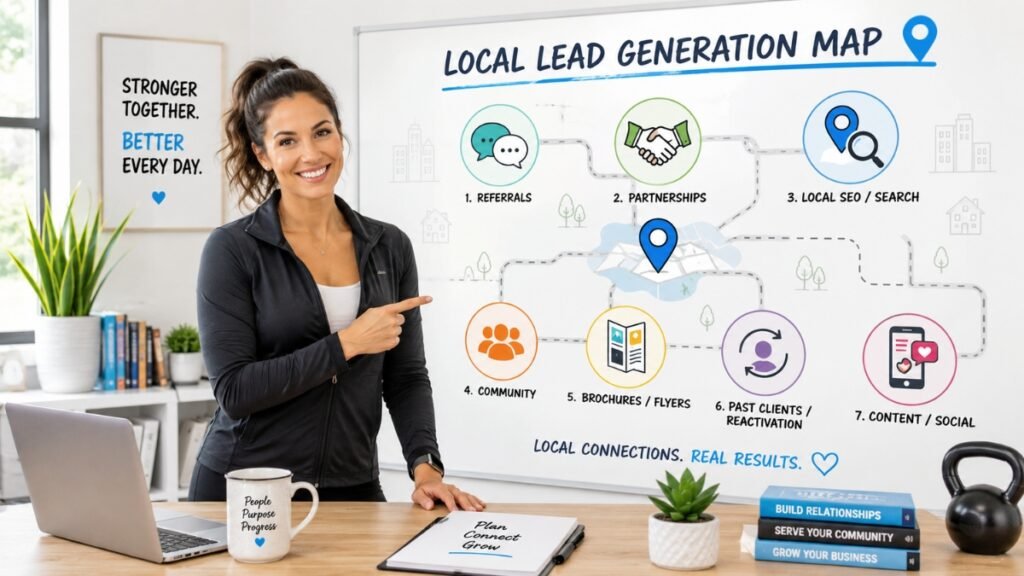
If you are trying to build a real personal training business, local leads still matter.
That is true whether you are an employee trainer trying to get more traction, an independent trainer trying to stop relying on random referrals, or a future studio owner trying to build a business that can scale. The mistake many trainers make is thinking lead generation is just about getting attention. It is not. The real goal is getting the right people to raise their hand, book a consultation, and become long-term clients.
That is why local lead generation still works so well. It reaches people who can actually show up, buy, and stay.
The bigger mistake is not tracking what happens next. A lead source is not good because it produces inquiries. A lead source is good because it produces consultations, sign-ups, retention, and real client value.
📌 Key Takeaways
- Local lead generation still works for personal trainers.
- Referrals, partnerships, local SEO, community visibility, old-school methods, reactivation, and local content can all produce strong leads.
- The real metric is not just lead volume. It is lead quality.
- Better businesses track source and conversion, not just inquiries.
- Local lead systems matter at every stage, from employee trainer through studio ownership.
🧭 Who this is for
This is for employee trainers who want to become more valuable and stop waiting for random floor traffic, independent trainers who want steadier local lead flow and better conversion, trainers working toward studio ownership who need stronger lead systems before they scale, and studio owners who want to improve lead quality, not just inquiry volume.
⚠️ The problem
Most trainers do not have a lead-generation problem as much as they have a lead-quality and tracking problem.
They may get inquiries, but they do not always know:
- where the best leads came from
- which sources produce booked consultations
- which leads actually show up
- which sources create better clients and better retention
That is why many trainers stay busy with marketing activity but still struggle to build a real business.
✅ The solution
The answer is not chasing every marketing trend.
The answer is to build a local lead system around sources that still work, then track:
- source of inquiry
- consultations booked
- consultations shown
- sales closed
- average program value
- retention by source if possible
The goal is not just more leads.
The goal is better leads.
🧱 Why local leads still matter
A personal training business is different from most online businesses because trust, convenience, and local reputation still carry serious weight.
People want to know:
- Are you nearby?
- Do you understand people like me?
- Does this feel safe, realistic, and welcoming?
- Can I see proof that this works for everyday people?
That is why local lead generation is not outdated. It is often more effective than broad, untargeted marketing because it reaches people who can actually show up, buy, and stay.
The goal is not just more leads. The goal is better leads.
1️⃣ Referrals
Referrals are still one of the highest-quality local lead sources in personal training.
The mistake is that most trainers treat referrals as something that “just happens” when people are happy. Sometimes they do, but a real business makes referrals part of the system.
That means:
- asking at the right time
- asking after a visible result or positive milestone
- giving clients a simple way to refer
- rewarding the behavior without making it feel awkward or pushy
The reason referrals work so well is simple. Trust is already transferred before the first conversation. The referred prospect is often easier to book, easier to close, and more likely to stay because someone they trust has already lowered the risk.
2️⃣ Local partnerships
Partnerships still work because most trainers ignore them.
A strong local partner already has access to the kind of people you may want to reach. That could include:
- physical therapists
- chiropractors
- massage therapists
- wellness businesses
- doctors who understand exercise and lifestyle change
- golf professionals
- senior-focused organizations
- local employers
The key is not collecting stacks of business cards. The key is building a real two-way relationship.
Good partnerships are based on:
- a clear audience fit
- a simple referral process
- consistent follow-up
- a message that helps their client, not just your business
A trainer who serves the deconditioned market especially well can do very well with local partnerships because that audience often needs reassurance, trust, and a softer entry point.
3️⃣ Local SEO and Google Business Profile
This is the newer local lead source that many trainers still underuse.
When someone searches for a trainer in their area, you want to show up where local intent is strongest. That usually means:
- a properly set up Google Business Profile
- consistent business details across the web
- reviews that mention real outcomes and local relevance
- pages on your website that clearly explain who you help and where you are located
You do not need to overcomplicate this. A personal training business can get good results by making sure the local signals are clear and the offer is easy to understand.
Good local SEO is not just about ranking. It is about matching what someone sees when they search:
- your reviews
- your tone
- your photos
- your location
- your business description
- your credibility
If the first impression feels confusing, hardcore, or generic, local traffic gets wasted.
4️⃣ Community visibility
Community still matters because personal training is a trust business.
This does not mean trying to be everywhere. It means being visible in the right places:
- local events
- charity involvement
- school or youth sports connections
- neighborhood publications
- wellness talks
- community Facebook groups
- business networking groups
- local presentations for companies or organizations
The point is not exposure for its own sake. The point is repeated familiarity.
When people see your name, hear your message, and understand who you help, it becomes easier for them to act later. For many trainers, community visibility works best when combined with a very clear niche message such as:
- weight loss for everyday adults
- strength and confidence for women over 40
- active aging and safe supervised training
- accountability-based training for busy professionals
Local visibility without a clear message is weak. Local visibility with the right message compounds.
5️⃣ Old-school direct-response methods
Some of the old methods still work because the market is less crowded there now.
That can include:
- flyer or brochure distribution in the right places
- referral cards
- direct mail in selected neighborhoods
- local print ads
- in-house promotion through partner businesses
- simple lead boxes or offers in local businesses
A lot of trainers dismiss these methods because they are not trendy. That is a mistake.
The real question is not whether a method is old. The real question is whether it reaches the right local audience with a strong offer and whether you track the response.
Old-school methods can work especially well when:
- your market is local
- your message is clear
- your offer is easy to understand
- your business stands out from the gym membership model
6️⃣ Reactivation and past contacts
This is one of the most overlooked lead sources because it does not feel exciting.
But for many trainers, old leads, former clients, and dormant contacts are far easier to convert than strangers.
That can include:
- former clients who left for life reasons
- people who inquired but never started
- people who started but did not continue
- old referral contacts
- people from your email list who never booked
Reactivation works best when the outreach is simple and relevant. Not a desperate sales blast. Just a clear reason to reconnect:
- a new offer
- a seasonal restart
- a progress check-in
- a new service angle
- a local event or assessment opportunity
A business with a decent contact list is often sitting on leads it already paid for once.
7️⃣ Content with local intent
Content still works locally when it is tied to a real local audience and a real local problem.
This is where old-school and new-school methods meet.
Examples include:
- blog posts targeting local search intent
- short local client-result stories
- videos answering local training questions
- neighborhood-specific landing pages
- social posts tied to local concerns and local language
The mistake is creating content that is broad, generic, and disconnected from the market you actually serve.
Better content answers questions like:
- Why do people in this area avoid gyms?
- What type of training works for busy adults here?
- What makes a personal training studio different from a gym membership?
- What should a beginner look for in a trainer near them?
Local content works best when it supports local search, local trust, and local conversion.
🔧 The real metric is not leads, it is lead quality
This is the biggest point in the whole article.
A lead source is not “good” just because it creates inquiries.
A lead source is good when it creates:
- booked consultations
- show-ups
- signed clients
- better-fit clients
- longer retention
- stronger lifetime value
That is why every trainer should track at least these numbers:
- source of inquiry
- consultations booked
- consultations shown
- sales closed
- average program value
- retention by source if possible
Once you do that, you stop guessing.
You may find that one source creates lots of weak leads, while another creates fewer inquiries but much better clients. That is how smart local lead generation works. It is not about chasing volume. It is about learning what brings in the right people.
🧱 What this means for trainers at different stages
If you are a Stage 1 employee trainer, local lead skills help you become more valuable and prepare you for the next level.
If you are a Stage 2 independent trainer, local leads help you stop relying on chance, social media mood swings, or a landlord gym that can change terms at any time.
If you are working toward Stage 3 studio ownership, local lead generation becomes even more important because now you are building a business, not just trying to fill your own diary.
The methods may evolve, but the principle stays the same:
clear message, local trust, track the numbers, improve what converts.
➡️ Next step
Where is your business actually leaking? The Personal Training Business Starter Kit includes a scorecard: five sections, 25 questions, scored out of 125. About ten minutes with a pen and you will know which part of the business is costing you money. → Get the free Starter Kit








Please help us by sharing on your favorite Social Media