
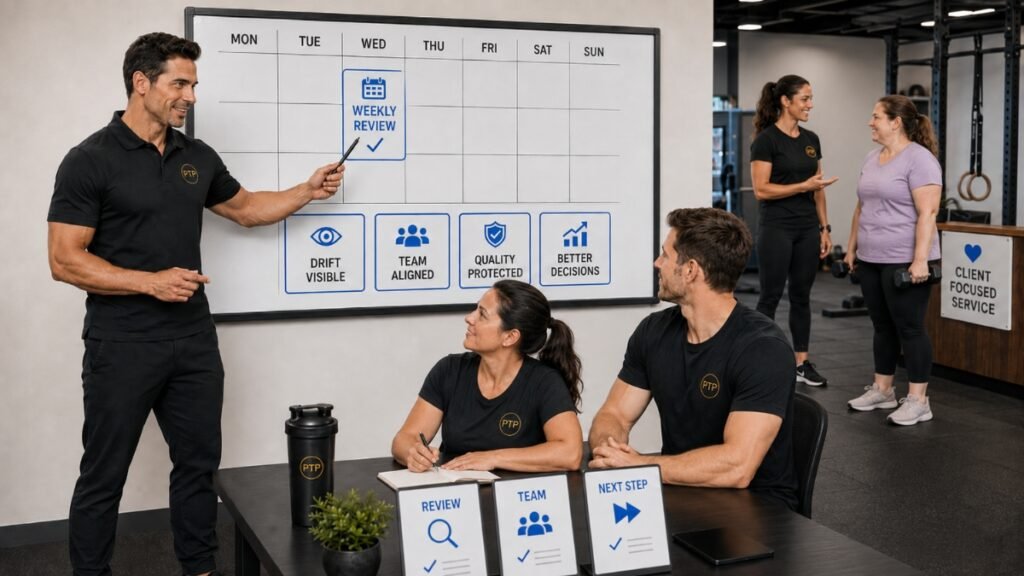
A personal training business does not stay controlled because the owner keeps everything in their head.
It stays controlled because the right things are reviewed at the right time.
That is what operating rhythm means.
Operating rhythm is the recurring pattern of review, action, and follow-up that keeps the business from drifting.
Without rhythm, the owner is left relying on memory.
Who missed sessions?
Who needs a reassessment?
Which numbers are weak?
Which staff issue needs attention?
Where is quality slipping?
That creates constant pressure.
A business that depends on the owner noticing everything in real time will eventually become reactive.
The owner may be busy.
The staff may be working.
Clients may be training.
The calendar may look active.
But if the right things are not reviewed on a predictable rhythm, small problems can build quietly in the background.
Operating rhythm gives the business a simple weekly checkpoint.
It helps the owner, manager, or leadership team see what matters, act faster, and stop managing by memory.
Prefer to watch? Here’s the full YouTube breakdown.
📌 Key Takeaways
- A busy personal training business can still be drifting.
- Operating rhythm means the recurring actions, reviews, and checks that keep the business on track.
- Daily rhythm protects the floor.
- Weekly rhythm protects the business.
- Weekly review should be short, focused, repeatable, practical, and action-based.
- The four key weekly review areas are metrics, reassessments, missed sessions, and quality checks.
- Missed sessions are retention signals, not just empty appointments.
- Reassessments should not depend on memory.
- Quality should be checked before clients complain.
- Operating rhythm is not bureaucracy. It is control without constant pressure.
🧭 Who this is for
This article is for personal trainers, independent operators, studio owners, and team leaders who:
- feel like they are always reacting;
- rely too much on memory;
- review numbers only when something feels wrong;
- forget reassessments until they become urgent;
- miss follow-up opportunities after missed sessions;
- struggle to keep staff aligned;
- want better control without adding unnecessary meetings;
- or need a simple weekly rhythm for managing the business.
This is especially useful for small personal training studios where the owner is still the main operator.
The goal is not to create corporate bureaucracy.
The goal is to build one repeatable weekly checkpoint that keeps the business visible.
⚠️ The problem
A personal training business can look active while still drifting.
Clients may be coming in.
Staff may be working.
The calendar may be full enough to feel busy.
The owner may be answering messages all day.
But activity is not the same as control.
When review is random, important problems build quietly.
Missed sessions may not trigger follow-up.
Reassessments may get forgotten.
Weak numbers may go unnoticed.
Trainer workload may become uneven.
Quality may drift before anyone names it.
Staff issues may linger.
Clients may quietly disengage.
The owner feels busy but unclear.
That is the danger of managing by memory.
The business keeps moving, but the owner does not have a clear weekly view of what needs attention.
✅ The solution
Install a simple weekly operating rhythm.
That means choosing a fixed weekly time to review the few things that keep the business from drifting.
The weekly rhythm should answer:
- What happened last week?
- What needs attention this week?
- Which numbers matter right now?
- Which clients need follow-up?
- Which reassessments need scheduling?
- Which staff or roster issues need correcting?
- Where is quality slipping?
- What is the top priority for the next seven days?
This does not need to become a long meeting.
It does not need to become a spreadsheet marathon.
It does not need to feel corporate.
It just needs to happen every week.
The best rhythm is the one the business will actually maintain.
1️⃣ Busy without rhythm becomes chaos
Busy can hide drift.
A studio may have clients coming in every day, but that does not mean the business is under control.
The owner may be active, but that does not mean the right things are being reviewed.
Staff may be doing their best, but that does not mean everyone is aligned.
The schedule may look full, but that does not mean retention, quality, and follow-up are being managed properly.
When review is random, the business becomes reactive.
A client misses sessions, but nobody follows up quickly.
A reassessment should have been booked, but it gets missed.
A trainer is overloaded, but the issue is not discussed.
The numbers are reviewed only when cash feels tight.
Quality starts to slip, but nobody catches it until a client complains.
That is activity without rhythm.
And activity without rhythm eventually becomes chaos.
2️⃣ Operating rhythm gives the business a cadence
Operating rhythm means the recurring pattern of actions, reviews, and checks that keep the business on track.
Some things should happen every day.
Some things should happen every week.
Some things only need deeper review each month.
The rhythm creates a default cadence.
Instead of asking, “What should I remember to check?” the business has a simple structure.
Daily rhythm keeps the studio ready.
Weekly rhythm keeps the business aligned.
Monthly rhythm creates space for deeper improvement.
This article focuses on the weekly rhythm because that is where many small studios lose control.
They are busy day to day, but they do not stop weekly to review what the business is actually telling them.
3️⃣ Daily rhythm protects the floor
Daily rhythm keeps today controlled.
It includes the practical routines that help the studio open well, stay prepared, and close properly.
Daily rhythm may include:
- opening routine;
- schedule review;
- floor readiness;
- client notes;
- supplies and hygiene checks;
- midday reset;
- issue flags;
- and close-out routine.
This work is not glamorous.
But it matters.
If the floor is not controlled daily, the client experience becomes inconsistent.
The team starts the day unclear.
Small issues carry into tomorrow.
Equipment, notes, supplies, or follow-up tasks get missed.
Daily rhythm protects the immediate client experience.
It keeps the studio prepared, safe, and professional.
But daily rhythm is not enough by itself.
The business also needs weekly rhythm.
4️⃣ Weekly rhythm protects the business
Weekly rhythm is where the owner, manager, or leadership team steps back from the immediate floor activity and reviews the bigger pattern.
This is where the business becomes visible.
A weekly review should ask:
- What happened last week?
- What needs attention this week?
- Which numbers matter right now?
- Which clients need follow-up?
- Which reassessments need to be scheduled?
- Where is quality slipping?
- Which staff or roster issues need attention?
- What is the top priority for the next seven days?
Without that weekly checkpoint, the owner is left relying on memory, stress, and whichever problem feels most urgent.
With a weekly rhythm, the business becomes easier to lead.
Daily rhythm protects the floor.
Weekly rhythm protects the business.
That distinction matters.
5️⃣ The weekly review should be short and useful
A weekly review does not need to be long.
It does not need to become a corporate meeting.
It does not need a giant spreadsheet.
It should be:
- short;
- focused;
- repeatable;
- practical;
- action-based;
- and easy to maintain.
A solo operator may do it alone.
A small studio may do it with one lead trainer or manager.
A larger studio may turn it into a short weekly huddle.
The format can change based on the size of the business, but the principle stays the same.
Every week, the business needs a checkpoint.
That checkpoint should review what happened, what needs attention, who owns the next step, and what the priority is for the week ahead.
The best operating rhythm is not the most elaborate one.
It is the one the business will actually maintain.
6️⃣ Review the numbers every week
The first weekly review area is metrics.
Numbers should not only be reviewed when something feels wrong.
That is too late.
A weekly numbers review keeps the owner close to reality.
Start with practical numbers:
- sessions delivered;
- missed or canceled sessions;
- consultations booked;
- new clients started;
- revenue collected or expected;
- trainer utilization;
- attendance concerns;
- and retention concerns.
These numbers do not need to create a giant reporting system.
They simply give the owner enough visibility to understand the health of the business.
Without numbers, the owner is often left with vague feelings.
“We feel quiet.”
“The schedule feels messy.”
“The week felt slow.”
“The trainers seem busy.”
Those feelings may be real, but they are not precise enough to guide a business decision.
A weekly review turns vague stress into clearer questions.
Are sessions delivered down?
Are missed sessions increasing?
Are consultations weak?
Are new starts lower than expected?
Is trainer utilization falling?
Is attendance slipping?
The numbers do not fix the business by themselves.
But they show the owner where to look first.
That is why weekly metrics matter.
7️⃣ Review reassessments before they are forgotten
The second weekly review area is reassessments.
Reassessments should not depend on memory.
They are too important to be handled casually or at the last minute.
A weekly rhythm should identify:
- which clients are due for review;
- which reassessments need to be booked;
- which clients need progress reviewed;
- who owns the follow-up;
- and what the next phase should be.
This matters because reassessments connect the client journey.
They help the client see progress.
They help the trainer explain what changed.
They give the next recommendation a professional basis.
They prevent the business from treating training as random sessions with no clear review point.
When reassessments are forgotten, the client journey becomes weaker.
The client may keep attending sessions, but progress feels vague.
They may not understand what has improved.
They may not know what should happen next.
The trainer may still be doing good work, but the business fails to turn that work into a clear review.
That weakens retention.
It also makes the next recommendation feel rushed.
A weekly operating rhythm keeps reassessments on the calendar before they become urgent or forgotten.
8️⃣ Treat missed sessions as retention signals
The third weekly review area is missed sessions.
Missed sessions are not just empty appointment blocks.
They are retention signals.
A client who misses sessions may be:
- losing momentum;
- struggling with schedule;
- becoming discouraged;
- dealing with pain or discomfort;
- drifting from the program;
- or moving quietly toward cancellation.
The weekly review should ask:
- Who missed?
- Why did they miss?
- Were they contacted?
- Was the session rescheduled?
- Is a pattern forming?
- Does the trainer understand what is happening?
- Does the owner or manager need to step in?
Too many businesses wait until the client has already drifted before they respond seriously.
A weekly rhythm keeps missed-session follow-up visible.
This does not mean every missed session is a crisis.
But it does mean missed attendance should not be ignored.
Consistent attendance is one of the strongest signals that the client is still engaged.
When attendance slips, the business should notice and respond.
That is retention work.
9️⃣ Check quality before clients complain
The fourth weekly review area is quality.
Quality should not be reviewed only when a client complains.
Most clients do not complain immediately.
They notice first.
They feel the service slipping.
They become less engaged.
Then they leave, or they quietly stop referring.
A weekly quality check helps the owner catch small issues early.
Review:
- session starts;
- trainer preparation;
- client notes;
- floor presentation;
- punctuality;
- follow-through;
- handoffs;
- staff communication;
- and client experience signals.
Quality drift usually starts small.
A session starts five minutes late.
A note is not updated.
A handoff is messy.
A follow-up is delayed.
A trainer assumes someone else explained the next step.
The floor is not quite as clean or ready as it should be.
None of these may feel dramatic in the moment.
But small slips add up.
Clients feel the difference even when they cannot name it.
A weekly rhythm gives the business a chance to catch those slips while they are still small.
The goal is not perfection.
The goal is consistency.
And consistency requires review.
🔟 Use the weekly huddle to align the team
For a team-based studio, the weekly rhythm may become a short weekly huddle.
This is not a long meeting.
It is a practical alignment point.
A weekly huddle may review:
- last week;
- this week’s schedule;
- key numbers;
- client concerns;
- operations issues;
- staff support needs;
- and immediate priorities.
Staff should not arrive empty-handed if they are part of the review.
They should bring useful information.
Which clients need attention?
Who missed sessions?
Which reassessments are coming up?
Are there any schedule problems?
Is anything happening on the floor that needs fixing?
Does anyone need support?
Are there any questions about standards or procedures?
This is where staff leadership becomes practical.
The owner is not trying to read everyone’s mind.
The team has a recurring place to bring the right information.
That improves communication, accountability, and service consistency.
The owner or manager should not try to solve everything in the meeting.
Instead, the weekly rhythm should produce clear decisions:
- who needs follow-up;
- what gets scheduled;
- which reassessments need to be booked;
- which number matters most this week;
- what quality issue needs correction;
- who owns each action;
- and what the top priority is for the next seven days.
The weekly review should produce clear next actions, not just discussion.
⚙️ Weekly rhythm reduces firefighting
Weekly rhythm reduces firefighting because it catches problems earlier.
Firefighting usually happens when the business notices something too late.
A missed session becomes a cancellation.
A staff misunderstanding becomes a client complaint.
A weak number becomes panic.
A forgotten reassessment becomes a rushed sales conversation.
A small quality slip becomes a retention problem.
The weekly rhythm does not remove every problem.
No system can do that.
But it gives the business a better chance of seeing issues while they are still manageable.
That is the difference between reacting all week and leading the business with rhythm.
Operating rhythm is not bureaucracy.
It is control without constant pressure.
🎯 This week’s action step
Create your first weekly operating rhythm checklist.
Start simple.
Write down:
- The day and time of your weekly review
- The numbers you will review
- The reassessments due this week
- The missed sessions needing follow-up
- One quality check
- One staff or roster issue
- The top priority for the next seven days
Your first version might include:
- sessions delivered;
- missed or canceled sessions;
- consultations booked;
- new clients started;
- reassessments due;
- client follow-ups required;
- quality concerns;
- and top priority.
Do not overcomplicate it.
The goal this week is not to build a perfect management system.
The goal is to create one repeatable weekly checkpoint.
A useful Ask-a-Coach post might look like this:
Our studio is starting a weekly review every Monday at 11 a.m. We plan to review sessions delivered, missed sessions, reassessments due, consultations booked, and one quality issue. What would you add or remove for a small one-trainer studio?
That is how operating rhythm begins.
One clear review.
Every week.
Same time.
Same core questions.
Better control.
The key takeaway
A strong studio runs on rhythm, not reaction.
The owner should not have to remember everything, chase everything, and notice every issue by accident.
A weekly review helps the business see problems earlier.
It helps the team act faster.
It keeps staff aligned.
It protects quality.
It makes client follow-up more consistent.
It keeps reassessments visible.
And it reduces the burden on owner memory.
That is what operating rhythm is really about.
It is not bureaucracy.
It is control without constant pressure.
Daily rhythm protects the floor. Weekly rhythm protects the business.
➡️ Next step
Start here: join the Personal Training Profits Academy community on Facebook to get the Free Personal Training Business Starter Kit and the weekly scorecard template.
If you want deeper implementation support, join the Personal Training Profits Academy on Skool.








Please help us by sharing on your favorite Social Media