
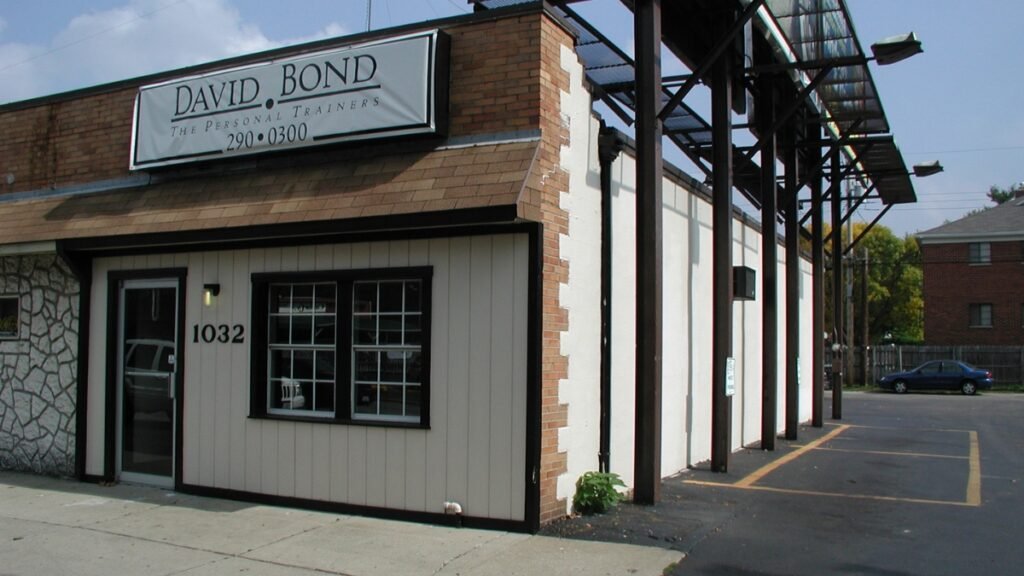
Bigger is not always better in personal training.
A large facility may look impressive, but it also brings higher rent, more equipment, more staffing, more maintenance, and more pressure to fill capacity. A compact personal training studio can often reach profitability faster because it is simpler to open, less expensive to equip, easier to manage, and built around the service clients are actually paying for.
This case study follows the rebuilding of David Bond’s personal training business in an approximately 850-square-foot commercial studio in Oakwood, Ohio.
It became one of the clearest real-world examples of the basic model I now teach through Studio OS:
Small studio, serious income, simple model.
It also carries a deeper personal meaning for me.
This case study is dedicated to the memory of David Bond, a former Marine, Desert Storm veteran, trusted colleague, and one of the finest personal trainers I have ever known or worked with. His ability to connect with people, retain clients, and help them achieve meaningful results deserves to be remembered.
📌 Key Takeaways
- A micro studio of around 1,000 square feet or less can support a strong owner-operator personal training business.
- Low overhead can allow a studio to cover its costs and become profitable relatively quickly.
- A controlled commercial studio is usually more secure than relying on a gym-rental arrangement or an unprotected residential setup.
- Personal training skill alone does not create a business. Systems, people skills, positioning, and ownership thinking matter.
- A trainer does not need a large franchise-style facility or extensive business experience to begin.
- The business model can be learned, documented, and improved one system at a time.
- Bigger facilities do not automatically create better economics, better client results, or a better life for the owner.
🧭 Who this is for
This case study is especially relevant to:
- employed trainers considering becoming independent;
- independent trainers renting space inside commercial gyms;
- home-based trainers worried about security or long-term control;
- experienced trainers who believe opening a studio is financially out of reach;
- owner-operators considering a larger facility than they really need;
- and trainers who are technically capable but have limited business experience.
The lesson is not that every trainer should immediately sign a commercial lease.
The lesson is that a private micro studio may be far more achievable than many trainers realize when the space, equipment, lease, systems, and client base are approached intelligently.
Table of Contents
- Case Study ID
- Background and context
- Starting point
- The problem
- The decision
- The build
- The numbers
- What changed and why
- What I learned
- Then vs now
- Next step
Case Study ID
Case Study Name: David Bond – The Personal Trainers
Time Period: 2005 to 2015
Location: Oakwood, Ohio, USA
Business Name: David Bond
Trading Identity: The Personal Trainers
Business Model: Owner-operator micro personal training studio
My Role: Consultant and coach
Approximate Studio Size: 850 square feet
This case study covers a 10-year period and brings the story much closer to the modern personal training market.
Unlike several of my earlier case studies, I was not the founder, equity owner, or operator of this business. My role was to help an established trainer recover, rebuild, reopen, and then refine a compact owner-operator studio model.
It is also one of the clearest examples of how a small, properly structured studio can create control, stability, and substantial income without the cost or complexity of a large facility.
1️⃣ Background and context
Between the end of the previous case study and the beginning of this one, I had been pulled in a very different direction.
I became heavily involved in an unrelated business that grew extremely quickly and eventually generated eight figures in annual sales. At its peak, that business produced individual months exceeding $4 million.
It took me around the world and gave me a tremendous amount of experience outside the fitness industry.
That period was important because it separated me from the identity I had carried for most of my working life. I was no longer proving only that I understood powerlifting, fitness equipment, personal training, or studio development. I had proven to myself that I could enter an industry I initially knew very little about, learn the business, build systems, and operate at a significant scale.
That wider experience strengthened something I already believed:
The industry may change, but the fundamentals of business do not.
You still need positioning, lead flow, sales, delivery, retention, financial control, clear roles, and repeatable systems.
I had first met David Bond in late 1995, during the early development of the personal training business that came before Just Results.
At the time, my then-partner and I had a small rented sales office near the commercial gym where we were conducting personal training. As the business became busier and we needed more trainers, David entered the picture.
David was a former Marine and a Desert Storm veteran. He had substantial hands-on training experience from his time in the forces and quickly became one of the key trainers in the business.
Later, when I left that operation and returned to build Just Results, David became a partner in Just Results and served as one of its two Program Directors.
About two years into Just Results, David left to build something of his own. He started operating as David Bond – Professional Fitness Trainer and developed a successful home-based studio in Oakwood, Ohio, a prestigious suburb with a strong high-income demographic.
He did extremely well.
From 1999 to 2004, David was generating more than $100,000 per year as an individual personal trainer from that owner-operator setup.
What made him successful was not an endless list of advanced certifications.
David was one of the most charismatic and naturally gifted trainers I had ever met. He was exceptional with people. Clients trusted him, enjoyed being around him, stayed with him, and achieved excellent results.
That is an important part of this story.
A trainer needs a legitimate baseline certification and must be competent and safe. But in all the consultations I have conducted over the years, I cannot recall clients choosing a trainer because that person had accumulated the largest number of advanced certificates.
Clients buy trust, connection, confidence, support, and the belief that you can help them solve their problem.
Around 2005, David called me while I was preparing to leave the country on business.
He was in a very difficult position.
David had developed an addiction problem. His business had declined sharply, many of his clients were gone, and he had lost the location from which he had been operating.
One of the vulnerabilities was that the home-based location had been tied to a residential arrangement rather than a secure commercial lease. Whatever the other circumstances, it did not give him the protection or control normally available through a properly structured commercial agreement.
David was in tears and asking for help.
I told him that when I returned, I would sit down with him and help him get his business back on track.
That is what made this case study different from the earlier ones.
I was not building another facility for myself. I was not trying to create a large franchise or negotiate with a large public company.
I was helping a friend rebuild his livelihood—and, in many ways, rebuild his life.
What I brought into the situation was everything I had learned through the earlier businesses: studio systems, pricing, consultations, positioning, operations, local marketing, facility selection, leases, renovations, staffing, and practical business setup.
When I returned, we prepared a short business plan, found a small commercial location on the same street as his previous setup, and began rebuilding.
The space was only about 850 square feet.
This time, however, it came with a proper commercial lease.
I personally helped demolish, renovate, equip, furnish, and prepare the new studio. I remained involved through the reopening and into the recovery period as David found his feet again.
That became David Bond, The Personal Trainers.
“The industry may change, but the fundamentals of business do not.”
2️⃣ Starting point
When this chapter began in 2005, I was already extremely busy with the other business.
I was not looking for another major venture, and I was not trying to create another full-scale operation for myself.
My goal was straightforward:
Help David get back on his feet.
That meant more than finding an empty room and moving in some equipment.
I helped him with:
- securing the location;
- understanding the lease;
- preparing the business plan;
- renovating the studio;
- recovering and installing equipment;
- paperwork and agreements;
- the logo and business identity;
- the website;
- early social media;
- signage;
- and local advertising.
By that stage, I was not guessing about the personal training model.
The earlier ventures had already solved most of the commercial questions. I understood the consultation process, program structure, client experience, reassessments, staffing logic, local lead flow, and basic studio economics.
I was also confident in David.
He was one of the most effective personal trainers I had ever seen. His personality, people skills, reputation, and ability to get results meant that the demand side of the equation could recover if we restored the structure around him.
What was still evolving was the ideal size of the owner-operator studio.
The first smaller Just Results location had been approximately 1,500 square feet. During later Nautilus discussions, I had explored mini in-club concepts under 1,000 square feet, including the possibility of converting unused racquetball courts into private personal training environments.
David’s new studio brought that thinking into a live commercial location.
At approximately 850 square feet, it became an important real-world test of how small a dedicated owner-operator studio could be while still delivering a professional experience and supporting more than one trainer.
The location had several practical advantages:
- it was positioned near a reasonably busy intersection;
- it offered convenient parking;
- it had good signage visibility;
- it included a change room;
- it had a toilet;
- and it even had a shower.
The shower was a bonus rather than a necessity.
In my experience, most studio clients do not regularly use extensive wet areas. But a toilet is essential, as is a modest changing area. A micro studio does not need to imitate a health club. It needs to provide what the personal training client genuinely requires.
By 2005, personal training studios were becoming more common around the metropolitan area. Former employees and independent trainers were beginning to open their own small operations.
The market was growing, but the same strategic confusion remained.
Many trainers still thought bigger premises, more machines, and a more gym-like environment automatically created a better business.
David’s studio gave us the opportunity to prove the opposite.
It was a live test of how small, efficient, and focused a personal training studio could be while still producing a strong owner-operator income.
3️⃣ The problem
The wider personal training model was not radically different from what it is today.
The private, results-driven, time-efficient studio model was already proving itself. Pricing has changed, technology has improved, and modern systems are easier to manage, but the core commercial logic remains remarkably similar.
A well-run personal training studio works for the same fundamental reasons it worked then:
- clients receive professional guidance;
- the environment is controlled;
- the experience is private and less intimidating;
- sessions are scheduled;
- progress is tracked;
- and accountability is built into the service.
David’s immediate problem was more urgent.
He had been financially and professionally wiped out.
The addiction problem, decline in the business, and loss of the earlier location meant that his income had collapsed and many clients had moved on.
The first objective was not to design a sophisticated expansion plan.
It was to:
- secure a new studio;
- renovate it quickly;
- recover the usable equipment from storage;
- rebuild the basic operating structure;
- reconnect with former clients;
- restart local lead flow;
- and get David earning a living again as soon as possible.
There was also a larger strategic problem beneath the immediate crisis.
Many personal trainers still believed they were somehow operating inside the same business model as a commercial gym.
They expected gyms to send them leads, support their growth, protect their client base, or behave like aligned long-term partners.
But personal training and gym membership are fundamentally different businesses.
A commercial gym generally sells facility access to a broad membership base.
A personal training business sells professional guidance, accountability, scheduled support, progression, and results.
The customer is different.
The buying decision is different.
The experience is different.
The economics are different.
That misunderstanding causes trainers to build on the wrong foundation and then wonder why the relationship with the gym eventually becomes restrictive or one-sided.
In my experience, the more appropriate separation a personal training business can create from traditional gym logic, the better.
David’s business did not need a revolutionary new concept.
It needed the correct model applied properly.
That is why we reopened under the broader identity of David Bond, The Personal Trainers.
The plural was intentional.
His previous basement setup had been built primarily around David himself. The new commercial studio created enough room for additional trainers, broader operating hours, and less dependence on David personally conducting every session.
The model could support morning and evening coverage, with David working one part of the day and another trainer covering other hours when necessary.
We were solving more than a revenue problem.
We were also solving for:
- structure;
- leverage;
- capacity;
- continuity;
- and a more sustainable quality of life for the owner.
4️⃣ The decision
The “why now” moment was not really a market calculation.
It was about renewing a friendship with someone who had played an important part in my earlier success and who genuinely needed help.
David had been there during an important stage of my personal training career. Now he was in trouble, and I was in a position to help him.
The business model also made immediate sense.
Personal training was David’s trade. The studio systems were already familiar to him. The service had already been proven. A compact studio could be prepared far more quickly and inexpensively than a large franchise-style facility requiring extensive equipment, major construction, and a large staff.
The model was not complicated:
- obtain a suitable commercial location;
- keep the footprint small;
- use only the equipment required to deliver the service;
- restore the consultation and reassessment systems;
- reconnect with the local market;
- and allow David’s strengths as a trainer to do the rest.
From day one, I committed to helping him recover and rebuild.
But the project also gave me another opportunity to prove something I had believed for years:
A compact personal training studio can work extremely well.
We professionalized the business, installed the signage, built the basic online presence, used local newspaper advertising, distributed brochures, placed brochure stands, added vehicle signage, and reconnected with the surrounding community.
Because David already had a reputation and a small number of loyal clients, the recovery happened quickly.
A few years later, after my unrelated business was sold in 2009, I began thinking seriously again about the personal training studio model.
Around 2010, David and I started discussing whether this type of compact owner-operator studio could be expanded more formally.
I had already secured the domain PersonalTrainingStudios.com and was operating under that business identity. Later, another studio opportunity emerged under a licensing-style arrangement, and David became involved in helping train trainers while we explored whether multiple small studios could operate under one broader system.
The formal arrangement never fully materialized.
We could not reach complete agreement on the naming and identity structure, and I understood David’s reluctance to give up the identity he had spent years rebuilding.
We continued to support one another as colleagues, but the larger licensing structure was never formally completed.
Even so, those discussions continued moving my thinking in the same direction.
The future did not necessarily need to be built around large facilities, wealthy investors, or complex franchise agreements.
It could be built by helping capable working trainers establish their own small, efficient studios under a proven operating system.
5️⃣ The build
The build for David Bond, The Personal Trainers was deliberately simple.
That simplicity was one of its greatest strengths.
Local lead flow
Lead flow came from a small number of practical local channels:
- brochure stands;
- permanent studio signage;
- vehicle signage;
- local networking;
- local newspaper advertising;
- referrals;
- and David’s existing reputation.
The studio’s position near a busy intersection gave it useful visibility.
Vehicle signage also helped. Even today, I believe a professionally branded vehicle can be an effective local awareness tool for the right personal training business. It repeatedly exposes the business name to people living and working inside the service area.
We were not trying to build a national brand.
We needed to reach suitable people living within a convenient distance of the studio.
That is one of the advantages of a local one-to-one business: you do not need millions of impressions. You need the right number of qualified prospects inside a relatively small radius.
The consultation process
The consultation process followed the same four-part logic David had learned years earlier:
- Build rapport.
- Listen carefully.
- Understand the real issue.
- Present the appropriate solution.
When this process is handled properly, the sale often becomes the natural next step.
The prospect feels understood. The recommendation is connected to what they said. The trainer is not forcing a generic package onto someone who has not yet explained their needs.
This was not gym-style selling.
It was a professional conversation built around the person’s goals, history, barriers, and desired outcome.
The service
The delivery model was straightforward:
- private personal training;
- primarily one-to-one;
- occasional one-to-two training;
- a non-intimidating environment;
- structured programming;
- measurable progression;
- and regular accountability.
The pricing structure included both 60-minute and 30-minute sessions, with occasional dual training where appropriate.
The studio did not need to offer every service available in a commercial fitness center.
It needed to deliver personal training well.
Retention
Retention was exceptional.
David’s personality and people skills were major factors. Clients enjoyed training with him, trusted him, and often remained for years.
The studio environment strengthened that relationship because it was private, familiar, and built entirely around the personal training experience.
Clients were not entering a crowded facility where the trainer had little control over noise, traffic, equipment availability, or the wider culture.
They were entering David’s business.
Operations
Operationally, very little needed to be invented.
Most of the systems came directly from the earlier models:
- every new client began with a consultation;
- assessments and reassessments were built into the process;
- programming was results-driven;
- client progress was reviewed;
- expectations were clear;
- and the service followed a consistent structure.
David had already learned these systems and had used them for years.
The key was putting the structure back around him.
Staffing
The The Personal Trainers identity allowed the business to grow beyond David alone.
Within a relatively short period, part-time trainers were contributing to the studio and adding income.
Despite being only about 850 square feet, the layout could accommodate as many as three trainers working at once when necessary.
That was close to the physical limit of the space, but it demonstrated the capacity available inside a carefully organized micro studio.
David remained fully booked, developed another trainer to close to a full-time schedule, and used one or two additional part-time trainers at different stages.
I also supported the build practically.
I lent David money, helped with demolition and renovation, supplied some office furniture, and assisted with the physical and administrative setup.
The greatest early advantage, however, was that David still had a small following.
A number of loyal clients were ready to return when he reopened. That meant he was covering overhead and beginning to make a living again within weeks.
“The studio did not need to become large before it became viable.“
That is the central advantage of the micro-studio model.
6️⃣ The numbers
David reopened with approximately a dozen clients who had essentially been waiting for him to return.
That was not a huge client base, but it was enough to create immediate revenue and begin covering the modest overhead.
As soon as the studio reopened, more clients began returning and new clients began joining.
We used advertising when it was needed in the early period. But it did not take long before ongoing paid lead generation became far less important. David’s local reputation, referrals, visibility, and retention kept the business moving.
Within approximately one year, David was again generating more than $100,000 in annual personal training revenue from his own book of business.
The exact number of monthly leads is less important than the efficiency of the model.
Conversion was consistently strong because David was excellent with people and already had credibility in the community.
Retention was also well above average. Many clients remained with him for years.
The approximately 850-square-foot studio could support:
- David with a full client schedule;
- another trainer working close to full-time;
- and one or two part-time trainers at different stages.
At peak times, as many as three trainers could operate inside the space.
The most important financial lesson was how quickly such a small studio could cover its overhead.
A large facility often begins with substantial fixed costs:
- higher rent;
- a larger deposit;
- more extensive renovations;
- more flooring;
- more equipment;
- more utilities;
- more insurance exposure;
- and greater staffing needs.
A micro studio requires far less.
The fit-out can be relatively simple.
The equipment requirement is modest compared with a full gym because the studio only needs the tools required to deliver the program effectively. It does not need rows of machines or equipment designed to impress casual gym visitors.
That creates a comparatively lower-risk path for an experienced trainer who already has some clients, understands service delivery, and is willing to learn the business systems.
The model can reach break-even with far fewer clients.
It can become profitable before every hour is filled.
And it can grow gradually rather than forcing the owner to chase a large volume of clients simply to service the overhead.
That does not mean there is no risk.
Every lease, business, and market requires proper due diligence. But compared with opening a large studio, a compact operation can reduce the financial exposure substantially.
This case study strengthened my belief that, for many owner-operators, the ideal starting footprint is around 1,000 square feet or less.
Keep it tight.
Keep it efficient.
Reach profitability.
Then decide whether expansion is genuinely necessary.
7️⃣ What changed and why
This chapter was less about a few dramatic changes and more about the continued evolution of my thinking.
Watching David’s studio reopen quickly, cover its costs, and fill again reinforced something I had already been moving toward for years.
A studio did not need to be large to be successful.
It did not need a lavish reception area, rows of equipment, a large management team, or a complicated service menu.
An approximately 850-square-foot space could support a successful owner, another nearly full-time trainer, additional part-time help, and a loyal long-term client base.
That is a serious business.
One of the biggest things that changed for me during this period was what I stopped pursuing.
I stopped trying to build the future primarily through partnerships with wealthy individuals, large corporations, or public companies.
I had already experienced the delays, conflicting priorities, ownership questions, identity disagreements, and loss of control that can come with those arrangements.
I became increasingly interested in a much more practical mission:
Help capable personal trainers open and operate their own small studios.
Toward the end of this decade-long period, David and I discussed developing a licensing approach that could support multiple compact owner-operator studios.
That formal agreement never came together, but the discussion itself continued validating the model.
The micro studio was:
- practical;
- affordable compared with a large facility;
- quick to establish;
- easier to equip;
- easier to manage;
- easier to staff gradually;
- and capable of producing substantial income.
This chapter also reinforced an important distinction.
There is a difference between being a great personal trainer and being a great business owner.
I would not describe David as the strongest businessman or owner-operator I ever knew.
But as a personal trainer, he was among the best.
His ability to connect with people was exceptional. He could attract clients, make them feel comfortable, retain them for unusually long periods, and help them achieve meaningful results.
He had a natural gift for the craft.
That distinction matters because many trainers assume technical excellence will automatically create business success.
It will not.
The craft is essential, but the business still needs systems around it.
David succeeded when the right systems, location, structure, and commercial protection were placed around his natural ability.
A few years after the period covered by this case study, David passed away.
That is why I wanted to tell this story carefully and respectfully.
It is a business case study, but it is also a record of someone who was extraordinarily good at the human side of personal training.
8️⃣ What I learned
Several lessons from this case study remain central to what I teach today.
1. Around 1,000 square feet or less can be an excellent starting size
Larger studios can work. I have built and operated them.
But for most owner-operators, a compact studio around 1,000 square feet or less offers a powerful balance:
- lower overhead;
- sufficient training capacity;
- easier supervision;
- modest equipment needs;
- simpler staffing;
- a more intimate client experience;
- and a lower break-even point.
“The goal is not to own the largest facility. The goal is to operate the strongest business.”
2. The same systems work across different markets and studio sizes
The principles used with David were not unique to Oakwood.
Versions of the same operating logic had already worked:
- in Perth;
- in the Middle East;
- in large dedicated centers;
- in small studios;
- in facility-based arrangements;
- and in multi-trainer operations.
The details change, but the fundamentals remain consistent:
- clear positioning;
- local lead flow;
- professional consultations;
- structured programs;
- assessments and reassessments;
- strong delivery;
- retention;
- financial control;
- and documented operating procedures.
That consistency is important.
It shows that the result was not dependent on one unusual facility or one lucky moment.
3. Qualifications are necessary, but they are not the whole business
A trainer needs to be competent, certified, responsible, and committed to continuing education.
But certificates alone do not build a client base.
I have met trainers with more degrees than a thermometer who struggled to connect with clients, generate leads, conduct consultations, retain people, or operate a business.
Technical knowledge is one component.
A successful owner also needs:
- people skills;
- self-awareness;
- communication;
- positioning;
- marketing;
- sales;
- financial understanding;
- leadership;
- and systems.
Being good at training clients is the starting point, not the full business model.
4. Home-based studios can work, but control and protection matter
David’s original home-based setup had been highly successful.
So the lesson is not that home studios are automatically bad.
The lesson is that the structure around the location matters.
A trainer relying on a residential lease, informal permission, zoning uncertainty, or an arrangement that can change suddenly may be building on a vulnerable foundation.
A properly structured commercial location can provide clearer business rights and greater long-term security, particularly when the lease has been reviewed by an appropriate professional.
The same principle applies to commercial gym rental.
If someone else controls the premises, they may ultimately control the future of the business.
5. Owner-operators have a major opportunity
A capable trainer with their own small studio can:
- control the environment;
- choose the positioning;
- protect the client experience;
- set the pricing;
- build the brand;
- employ or contract additional trainers;
- create an asset;
- and develop a more secure future.
That is a fundamentally stronger position than depending indefinitely on a gym, club, or informal facility arrangement.
This case study reinforced my belief that serious trainers should move toward a controlled, properly structured studio environment when it becomes practical for them to do so.
That belief eventually became part of the foundation for Personal Training Profits and Studio OS.
9️⃣ Then vs now
There is a great deal from this case study that I would keep today.
What I would keep
I would keep:
- the approximately 850-square-foot footprint;
- the low overhead;
- the limited but appropriate equipment selection;
- the dedicated commercial location;
- the private and non-intimidating environment;
- the consultation-first client journey;
- the structured reassessments;
- the local lead sources;
- the one-to-one and occasional one-to-two delivery;
- and the ability to add another trainer gradually.
A small studio is easier to open, easier to control, easier to staff, and easier to keep profitable.
That remains one of the smartest paths available to a serious personal trainer.
What I would change
Honestly, I would change very little about the core model.
Technology would make several parts easier today:
- online scheduling;
- automated billing;
- lead tracking;
- email and text follow-up;
- digital assessments;
- client records;
- local search visibility;
- and financial reporting.
I would also make sure every critical agreement was documented and professionally reviewed from the beginning.
But the business model itself remains strong.
A trainer can use the clients, credibility, and experience gained as an employee or independent trainer to step into a modest studio without trying to build a large operation immediately.
What today’s trainer should copy
Today’s trainer should copy the logic, not necessarily every historical tactic.
Copy:
- the controlled environment;
- the small footprint;
- the low overhead;
- the simple equipment plan;
- the consultation system;
- the reassessment process;
- the local marketing;
- the retention focus;
- the gradual staffing model;
- and the protected commercial structure.
A trainer does not need to understand every area of business before beginning.
But they do need to be willing to learn.
If you took the time to learn anatomy, programming, coaching, assessments, and your personal training certification, you can also learn:
- lead flow;
- consultations;
- pricing;
- retention;
- basic financial management;
- scheduling;
- and operating systems.
Owning a business brings more responsibility.
It also brings more control.
Some trainers will prefer employment. Others may find an unusually good partnership or a high-end club that pays well and operates strong systems.
Those situations exist.
But for a trainer who wants to become master of their own destiny, building toward a small, controlled studio remains one of the clearest long-term paths.
A chef can prepare extraordinary food and still fail as a restaurant owner because cooking is only one part of the operation.
Personal training is no different.
“Training is the craft. Systems are the business.“
A great session helps a client achieve results.
A great system keeps the business alive.
Most trainers are not underqualified.
They are under-systemized.
The larger lesson: bigger isn’t always better
This case study is one of the clearest reasons I no longer believe the best path for most trainers begins with a large facility.
The 850-square-foot studio was:
- relatively quick to prepare;
- inexpensive compared with a full-size gym;
- modest in its equipment needs;
- capable of supporting several trainers;
- able to cover overhead with a relatively small client base;
- and capable of producing more than $100,000 in annual personal training revenue from the owner’s own schedule.
That is what makes the model achievable.
It is not reserved for wealthy investors, large franchise groups, or trainers with advanced business degrees.
A competent working trainer can learn the model step by step.
The risk can be reduced by keeping the space small, maintaining adequate cash reserves, choosing the lease carefully, using only necessary equipment, retaining existing clients, and installing proven systems before adding unnecessary complexity.
This is the model that sits beneath the Studio OS:
Small studio, serious income, simple model.
Not effortless.
Not risk-free.
But practical, teachable, and achievable for far more personal trainers than the industry often suggests.
🔟 Next step
Thinking about your own place? What a small studio costs to open, what 18 clients across 54 sessions a week actually produce, and the arithmetic to run before you commit to a lease. → The numbers behind your own studio
About the Author

Paul Barclay has been building supervised personal training studios since 1992, in Australia, the Middle East and the United States. That includes a Perth centre doing over $1,000,000 a year that expanded from one location to four, an Ohio studio franchise-ready by 2000, a Dallas turnaround that doubled monthly revenue, and an 850 square foot room that produced six figures a year for a decade.
In 1996 he presented a model to Nautilus arguing that three barriers keep most people out of gyms. The industry solved two of them and built a multi-billion dollar franchise category on the back of it. The third is still open.
Personal Training Profits exists to help people open studios they own outright, without a franchise fee and without a royalty in perpetuity.








Please help us by sharing on your favorite Social Media