There are two ways to own a personal training studio.
You can buy a franchise.
Or you can build an independent studio and own the business, systems, brand, and equity yourself.
The difference is much bigger than the initial franchise fee.
In this part of the personal training industry, published franchise entry fees can run roughly $49,500 to $58,000 before the doors open. Then ongoing royalty and brand-fund fees can take around 6% to 9% of gross revenue for as long as the franchise is owned.
Not profit.
Gross revenue.
That percentage becomes much more meaningful when it is converted into dollars.
Take a studio grossing approximately $1 million a year. At around 8% in combined ongoing fees, that is roughly $80,000 a year.
Over 10 years:
$80,000 × 10 = $800,000
Add an initial franchise fee of roughly $50,000 and the total reaches approximately:
$850,000
And after paying all of that, the franchise brand still belongs to somebody else.
There is another path.
Build the system.
Open the studio.
Own the brand.
Keep the equity.
This article explains what that independent path can cost, what the economics can look like, the order in which the decisions should be made, and the mistakes that can make studio ownership unnecessarily expensive.
Prefer to watch? Here’s the full YouTube breakdown.
📌 Key Takeaways
- A personal training franchise may cost far more than the initial franchise fee suggests.
- Ongoing royalties are generally calculated from gross revenue, not profit.
- A high-performing location can pay hundreds of thousands of dollars in franchise-related fees over a decade.
- A small independent personal training studio can often be opened for substantially less capital.
- Around 850 to 1,200 square feet can be enough for an owner-operator or small two-trainer model.
- An 18-client owner-operator example can produce roughly $140,000 in annual gross revenue.
- A well-run small studio can potentially produce around $100,000 before owner tax in the worked example.
- The independent route is not automatically easier. It requires the right systems and decisions in the right order.
- The lease should not be the first decision.
- Build for the underserved deconditioned market, not only people who already enjoy gyms.
- The real choice is not simply franchise versus independent. It is whether to rent someone else’s system indefinitely or build one you own.
🧭 Who This Is For
This article is for someone who is seriously considering owning a personal training studio.
That may include:
- an experienced personal trainer who wants their own facility;
- an independent trainer currently renting space inside a gym;
- a business-minded entrant considering a personal training franchise;
- an operator comparing franchise ownership with an independent model;
- or someone who wants a small, owner-operated business rather than a large commercial gym.
It is especially relevant if a franchise feels attractive because it provides a ready-made operating system.
That is a legitimate benefit.
The important question is what that system will ultimately cost you and whether there is another way to acquire the same business capability while retaining ownership of what you build.
⚠️ The Problem With Looking Only at the Franchise Fee
The initial franchise fee gets most of the attention because it is easy to see.
A prospective owner might look at an entry fee of roughly $50,000 and decide whether the convenience, training, systems, name, and support justify it.
But that is only the beginning of the economics.
The larger number may be the percentage of gross revenue paid every year afterward.
If ongoing royalty and brand-fund obligations total 6% to 9%, a studio does not stop paying because margins are tight.
The percentage is generally tied to gross revenue.
That means a successful location can pay substantially more than a weak location.
The better the studio performs, the larger the dollar amount sent to the franchisor.
That does not automatically make a franchise a bad decision.
A franchise may provide real value to a first-time operator who wants:
- an established operating format;
- training;
- manuals;
- supplier relationships;
- procedures;
- guidance;
- and a brand with some recognition.
The question is whether that value is worth the lifetime economics of the agreement.
✅ The Independent Alternative
An independent studio still needs systems.
It still needs:
- a viable market;
- pricing;
- lead generation;
- consultation systems;
- assessments;
- client onboarding;
- programming;
- retention;
- reassessments;
- operating procedures;
- staffing systems;
- and financial controls.
The difference is that those systems belong to the business owner.
Instead of paying a percentage of revenue indefinitely for access to somebody else’s operating model, the independent owner builds an operating model that becomes part of their own business asset.
That distinction matters when the business grows.
It also matters when the owner eventually wants to sell.
1️⃣ Understand What You Are Really Buying From a Franchise
The strongest argument for a franchise is not the logo.
It is the system.
A good franchise may give the operator:
- a tested format;
- operating procedures;
- training;
- supplier relationships;
- marketing guidance;
- sales processes;
- and a known way of doing things.
For someone with little business experience, those can be valuable.
But personal training is not the same as buying coffee or fast food.
Most clients do not choose a local personal training studio primarily because they recognize the national brand.
They are far more likely to care about things such as:
- location;
- convenience;
- trust;
- environment;
- personal recommendation;
- professionalism;
- and whether the studio feels appropriate for them.
That changes the value calculation.
If the major thing being purchased is the business system, the question becomes:
Could you acquire and implement the system without giving away a percentage of gross revenue indefinitely?
For some operators, the answer may be yes.
2️⃣ Turn the Franchise Percentage Into Dollars
Percentages are easy to underestimate.
Dollar figures are harder to ignore.
Assume a franchise charges an initial fee of approximately $50,000.
Then assume combined ongoing royalty and brand obligations of approximately 8% of gross revenue.
Consider three simple annual revenue levels.
At $300,000 in gross revenue:
8% = $24,000 per year
Over 10 years:
$240,000
Add the initial fee and the rough total becomes:
$290,000
At $600,000 in gross revenue:
8% = $48,000 per year
Over 10 years:
$480,000
Add the initial fee:
$530,000
At $1 million in gross revenue:
8% = $80,000 per year
Over 10 years:
$800,000
Add the initial fee:
$850,000
This is why the ongoing percentage deserves at least as much attention as the entry fee.
A percentage shown in a disclosure document may not feel particularly dramatic.
Attach 10 years and a successful studio to it, and the economics become much clearer.
3️⃣ Compare That With the Cost of Opening Independently
A small personal training studio does not necessarily require premium retail frontage or a large facility.
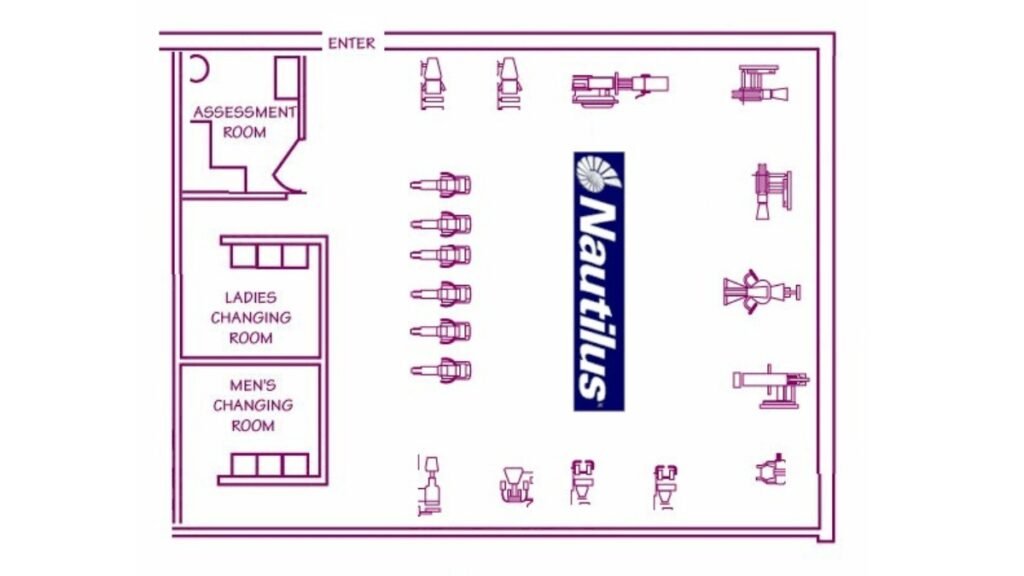
For an owner-operator or small two-trainer model, approximately 850 to 1,200 square feet can work well.
The priorities are more practical:
- easy access;
- adequate parking;
- appropriate demographics;
- a professional environment;
- suitable equipment flow;
- and reasonable occupancy costs.
A realistic independent startup budget might include:
Equipment: $28,000 to $30,000
Lease deposit and first month: $2,000 to $3,000
Fit-out: $0 to $15,000
Signage: $100 to $2,000
Website, booking, and payments: $500 to $3,000
Insurance, permits, and licensing: $1,000 to $3,000
Professional fees: $1,500 to $4,000
Pre-opening marketing: $3,000 to $6,000
Working capital: $7,500 to $15,000
Then allow a contingency.
Using the assumptions in this model, the total comes to approximately $48,000 to $89,000 if equipment is purchased outright.
If equipment is financed, the immediate cash requirement can fall to approximately $19,000 to $60,000.
The exact figure depends heavily on the location and unit.
But the comparison is important.
The independent startup cost can potentially sit in the same range as the franchise entry fee alone.
4️⃣ Do Not Forget Working Capital
Working capital is one of the most commonly overlooked startup costs.
Opening the doors does not mean the studio immediately operates at full capacity.
The business needs time to build.
Rent still has to be paid.
Software still has to be paid.
Insurance still has to be paid.
Marketing continues.
Utilities continue.
That is why the independent model should include several months of fixed costs as runway.
A reasonable planning range in the example is approximately:
$7,500 to $15,000
That represents roughly three to six months of basic fixed operating costs.
This money is not pre-opening marketing.
It is not equipment.
It is not fit-out.
It is the reserve that allows the business to survive the ramp-up period without making desperate decisions.
A studio that opens undercapitalized may have a good underlying model and still fail because it runs out of time.
5️⃣ Understand What a Small Studio Can Produce
A personal training studio does not need hundreds of clients to become a meaningful business.
Consider a simple owner-operator example.
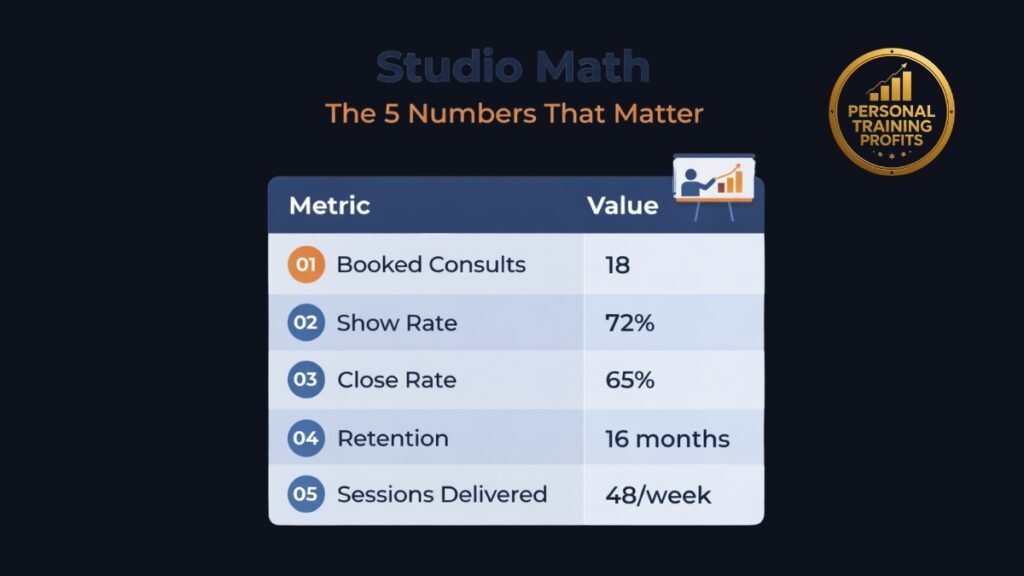
18 clients
Training:
3 times per week
At:
$50 per 30-minute session
That produces:
54 sessions per week
Approximately:
$11,700 per month
Or:
$140,400 per year in gross revenue
Using approximately $2,500 per month for occupancy, equipment financing, and basic accounting in the example, the model lands around:
$100,000 per year before owner tax
The delivery load is also worth understanding.
Fifty-four 30-minute sessions equal approximately:
27 hours of session delivery per week
Add approximately:
- 10 hours for sales and marketing;
- 6 hours for administration and assessments;
and the real working week is approximately:
43 hours
That is not passive income.
It is a real working business.
The difference is that those working hours are being used to build an asset the owner controls.
6️⃣ Look for Proof That the Model Works Without the Founder
The strongest proof of a business model is not that its creator can make it work.
The stronger test is whether somebody else can use the system successfully.
One useful example is David Bond, The Personal Trainers in Oakwood, Ohio.
The studio operated from approximately 850 square feet.
With the business system installed and David operating the studio himself, it produced more than $100,000 a year to its owner before tax, sustained over approximately a decade.
That distinction matters.
The operator was not the person who originally developed the system.
The system had to work in somebody else’s hands.
That is the standard an independent business system should eventually meet.
The business should not depend entirely on one unusually gifted trainer, salesperson, or founder.
It should become teachable and repeatable.
7️⃣ Understand Why Renting Space Is Different From Owning
Renting space inside a commercial gym can be an excellent starting point.
It reduces startup costs.
It gives a trainer somewhere to deliver sessions.
It may provide access to existing foot traffic.
For many trainers, it is a sensible first step.
But it has structural limitations.
A gym and a personal training studio are not the same business.
A gym primarily sells access.
A personal training business sells:
- supervision;
- appointments;
- accountability;
- guidance;
- progression;
- and results.
When a personal training business operates inside somebody else’s gym, the trainer may control the sessions.
But the facility owner may control:
- rent;
- operating rules;
- facility hours;
- access;
- the broader pricing environment;
- and ultimately whether the arrangement continues.
Management changes.
Rent increases.
Policies change.
Agreements end.
Renting space can help a trainer start.
Ownership provides a different level of control over where the business ultimately goes.
8️⃣ Make the Decisions in the Right Order
Most of the expensive mistakes in opening a personal training studio are not effort problems.
They are sequencing problems.
Decisions get made in the wrong order.
The safer sequence is:
1. Numbers and market
Understand:
- local session rates;
- the catchment area;
- demographics;
- competition;
- realistic demand;
- and whether the economics work at realistic capacity.
If the model does not work on paper, enthusiasm will not fix it.
2. Business model
Decide whether the studio will be:
- owner-operated;
- multi-trainer;
- or a larger commercial model.
That decision affects almost everything that follows.
3. Site and lease
Only after the numbers and model work should the business commit to a location.
A five-year lease on the wrong unit can be one of the most expensive mistakes available.
4. Offer and pricing
Determine what the studio sells and what it charges before opening.
5. Systems
Build the operating method:
- lead response;
- consultation;
- initial assessment;
- six-week starting phase;
- session delivery;
- reassessment;
- retention;
- and follow-up.
6. Pre-opening marketing
The goal is not simply to throw a launch party.
The goal is to open with appointments already booked.
7. Open
With the right location and an existing client base, approximately three months from decision to opening may be achievable.
Without either, expect the process to take longer.
9️⃣ Build for the Market Most Studios Ignore
One of the biggest strategic mistakes is building another facility for people who already like exercising.
Roughly three out of four adults do not meet basic physical-activity guidelines.
Many of those people are not comfortable walking into a busy commercial gym.
That is not a minor market.
It is the majority.
The opportunity is to create a personal training environment for people who need:
- supervision;
- confidence;
- accountability;
- privacy;
- a clear starting point;
- and an environment that does not make them feel as though they have to get fit before they arrive.
That market does not need another intimidating gym.
It needs a professional personal training business designed around its actual barriers.
This is where independent ownership can become an advantage.
The studio can be designed around the client rather than around a generic franchise template.
🔟 Avoid the Four Most Expensive Mistakes
Several mistakes can make an otherwise viable studio much harder to succeed with.
1. Signing the lease first
An attractive unit becomes available.
Someone else is supposedly interested.
The pressure begins.
But a five-year lease should come after the economics and model have been tested, not before.
2. Building for people who are already fit
That places the business into direct competition for the smaller percentage of people already comfortable in gyms.
The larger opportunity is often the deconditioned market that traditional facilities fail to serve well.
3. Pricing from the gym down the road
A gym sells access.
A personal training studio sells supervised appointments.
Those are different products.
The prices do not need to be built from the same logic.
4. Hiring too early
Adding another trainer before existing capacity is being used creates additional expense without solving a real capacity problem.
Staff should normally be added because demand requires more delivery capacity, not because having employees makes the business feel more established.
🎯 The Decision to Make Before Buying a Franchise
The question is not whether franchises are bad.
They are not automatically bad.
For some prospective owners, a franchise may provide exactly the structure and support they need.
The better question is:
What am I paying for, what will it cost over the life of the business, and what will I own at the end?
If a location reaches approximately $1 million in annual gross revenue and pays around 8% of revenue in ongoing franchise-related fees, the ten-year total can approach:
$800,000 in ongoing fees
Add approximately:
$50,000 in initial franchise fees
And the total reaches approximately:
$850,000
For that amount of money, a prospective owner should at least compare the alternative.
What would it cost to build an independent studio?
What systems would need to be installed?
What expertise would need to be purchased?
What would the economics look like locally?
And what would the business be worth if the owner kept the equity instead?
Those are the questions that should be answered before signing a franchise agreement.
The Key Takeaway
A franchise gives you a system you can use.
An independent studio requires you to build or acquire a system you can own.
That is the fundamental difference.
The work of running the studio remains remarkably similar.
Clients still need to be attracted.
Consultations still need to convert.
Assessments still need to be completed.
Sessions still need to be delivered.
Progress still needs to be tracked.
Clients still need to stay.
Staff still need systems.
The business still needs numbers.
The real difference is where the money goes and what remains yours.
A franchise can give you a business system. An independent studio can give you the system and the equity.
➡️ Next Step
The full independent studio cost build, worked economics, and franchise comparison are available free at PersonalTrainingProfits.net, with no email required.
The one question that cannot be answered with a generic national estimate is whether the numbers work in your specific market, at your local session rate, with the location you are considering.
That is where a site-specific feasibility analysis becomes useful.








Please help us by sharing on your favorite Social Media