
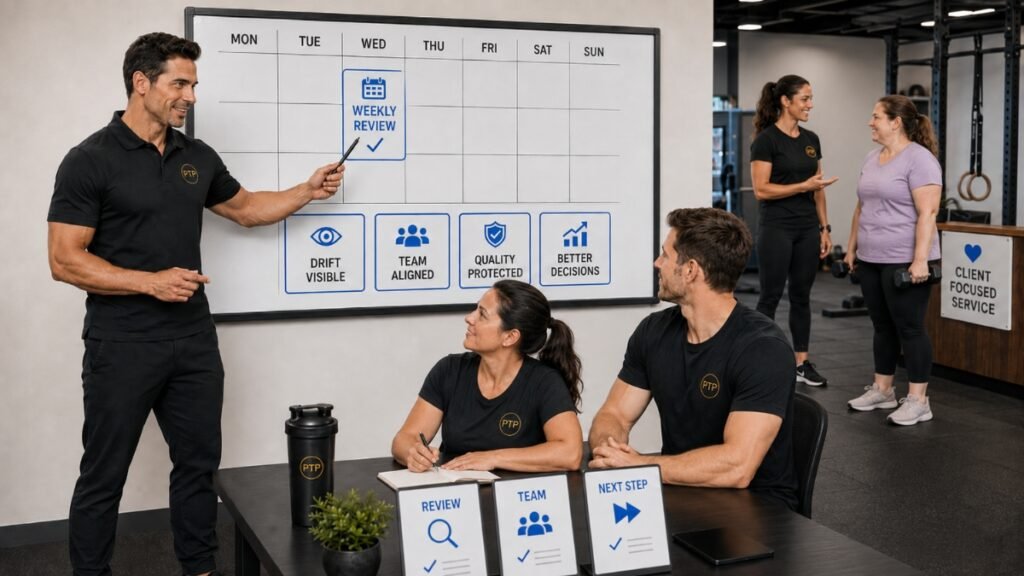
Personal training studio owner leading a weekly operating rhythm review with staff while a trainer supports a client in the background

Operating Rhythm for Personal Trainers

A personal training business does not stay controlled because the owner keeps everything in their head. It stays controlled because the right things are reviewed at the right time. That is what operating rhythm means. Operating rhythm is the recurring pattern of review, action, and follow-up that keeps the business from drifting. Without rhythm, the […]

Operating Rhythm for Personal Trainers Read More »
, , , , ,
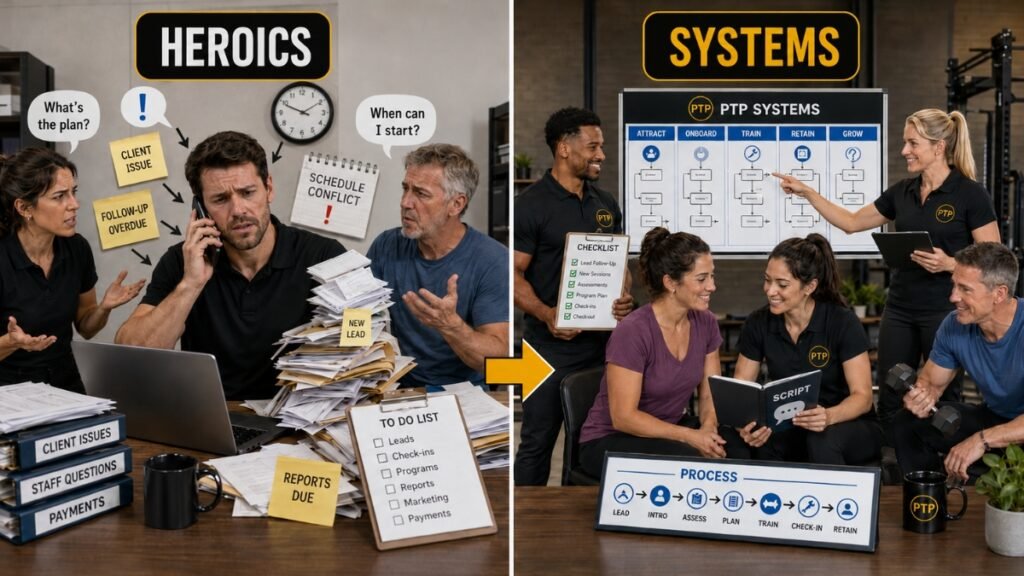
Heroics versus systems in a personal training business, showing chaos on one side and organized studio systems on the other

Systems, Not Heroics for Personal Trainers

A personal training business can look successful while still depending far too much on one person. The owner remembers the details. The owner fixes the problems. The owner answers every staff question. The owner saves the session, saves the client, saves the schedule, and saves the day. That may feel like commitment. But it is

Systems, Not Heroics for Personal Trainers Read More »

, , , ,
Capacity building concept with upward arrow, business icons, and handwritten planning visuals

Capacity and Utilization for Personal Trainers

A personal training business can feel busy without being properly utilized. The calendar may look full. The trainer may feel rushed. The owner may feel like there is no breathing room. But none of that proves the business is using its available training capacity well. Busy is a feeling. Capacity and utilization turn that feeling

Capacity and Utilization for Personal Trainers Read More »
, , , ,
Personal trainer explaining a six-week starting phase to a client during a private consultation

The 6-Week Personal Training Starting Phase

A strong personal training program needs a clear beginning. For many new clients, especially those who have struggled before, an open-ended commitment can feel difficult to understand and even harder to imagine completing. A six-week starting phase gives the client a defined first step. It creates enough time to establish a routine, build confidence, begin

The 6-Week Personal Training Starting Phase Read More »

, , , ,
Personal trainer explaining how clear positioning attracts the right clients during a small-group presentation

Personal Trainer Positioning That Attracts the Right Clients

Most personal trainers describe their business in almost the same way. They help people get fit, lose weight, become stronger, and feel healthier. Those statements may be true, but they do not explain who the service is designed for, what has kept that person stuck, why this particular business is different, or why the prospect

Personal Trainer Positioning That Attracts the Right Clients Read More »

, , , ,
Exterior of David Bond, The Personal Trainers micro studio in Oakwood, Ohio

Case Study – David Bond / The Personal Trainers (2005–2015)

Bigger is not always better in personal training. A large facility may look impressive, but it also brings higher rent, more equipment, more staffing, more maintenance, and more pressure to fill capacity. A compact personal training studio can often reach profitability faster because it is simpler to open, less expensive to equip, easier to manage,

Case Study – David Bond / The Personal Trainers (2005–2015) Read More »

, , ,
Personal trainer conducting a no-pressure consultation with a prospective client in a private office

No-Pressure Consultations: How Calm Structure Converts Better

Many good personal trainers dislike sales because they associate it with pressure, manipulation, scripts, fake urgency, and cheap closing techniques. But a professional consultation does not need any of that. The strongest consultations are calm, structured conversations where you listen first, understand the person’s real problem, recommend the right solution, and confidently help them decide

No-Pressure Consultations: How Calm Structure Converts Better Read More »

, , , ,
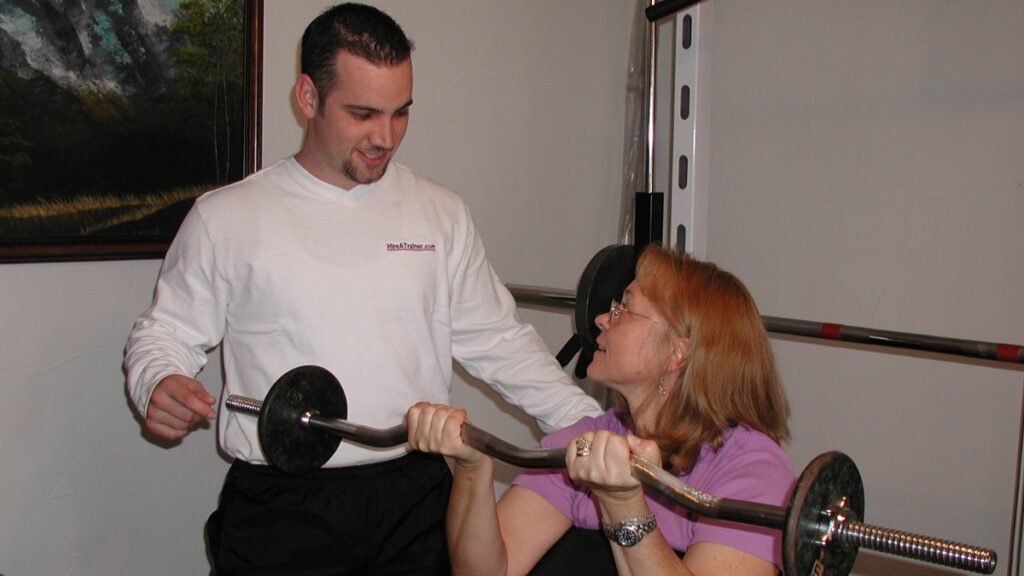
HireATrainer.com trainer conducting an in-home personal training session with a female client in Dallas, Texas

Case Study – Entering the Virtual World Before the Crowd Arrived (2002–2005)

Most personal trainers today think online training, virtual coaching, hybrid delivery, and trainer directories are modern ideas. They are not. This case study covers a period in the early 2000s when I was already testing in-home training, corporate facility training, online personal training, trainer directories, and web-based distribution. It was an important chapter because it

Case Study – Entering the Virtual World Before the Crowd Arrived (2002–2005) Read More »

, , , ,
Gears and cogs graphic representing a lead flow system and repeatable process for generating inquiries and consults

Lead Flow Systems, Not Luck

Most personal trainers don’t struggle because they’re bad at coaching. They struggle because lead flow is inconsistent. This blog complements this week’s classroom lesson by turning the concept into a simple, repeatable weekly system you can run without guessing. Prefer to watch? Here’s the full YouTube breakdown. 📌 Key Takeaways 🧭 Who this is for

Lead Flow Systems, Not Luck Read More »

, , ,
4.0 Studio storefront photo in a retail plaza with “40 Minutes to Fitness” signage, used for the Planet U case study (2000–2003)

Case Study – 4.0 Studio/Planet U (2000 – 2003)

This case study is a key bridge in my story, and in the Personal Training Profits story. Just Results proved the model could be built from scratch, systemized, and scaled. 4.0 Studio, later Planet U, proved something different: the same systems could be installed into an existing operation, turned around quickly, and pushed to national-level

Case Study – 4.0 Studio/Planet U (2000 – 2003) Read More »

, , ,
Scroll to Top